Separating True Innovation from Marketing Gimmicks
The consumer electronics market is moving toward smaller and more convenient charging solutions.
At the same time, consumers expect faster charging, better safety, and easier power monitoring.
For hardware buyers, distributors, and OEM procurement managers, this creates a sourcing challenge.
Not every new feature delivers meaningful consumer value or long-term ROI.
Therefore, buyers must distinguish genuine engineering improvements from short-lived marketing trends.
For built-in cable power bank products, three technologies stand out in this transition.
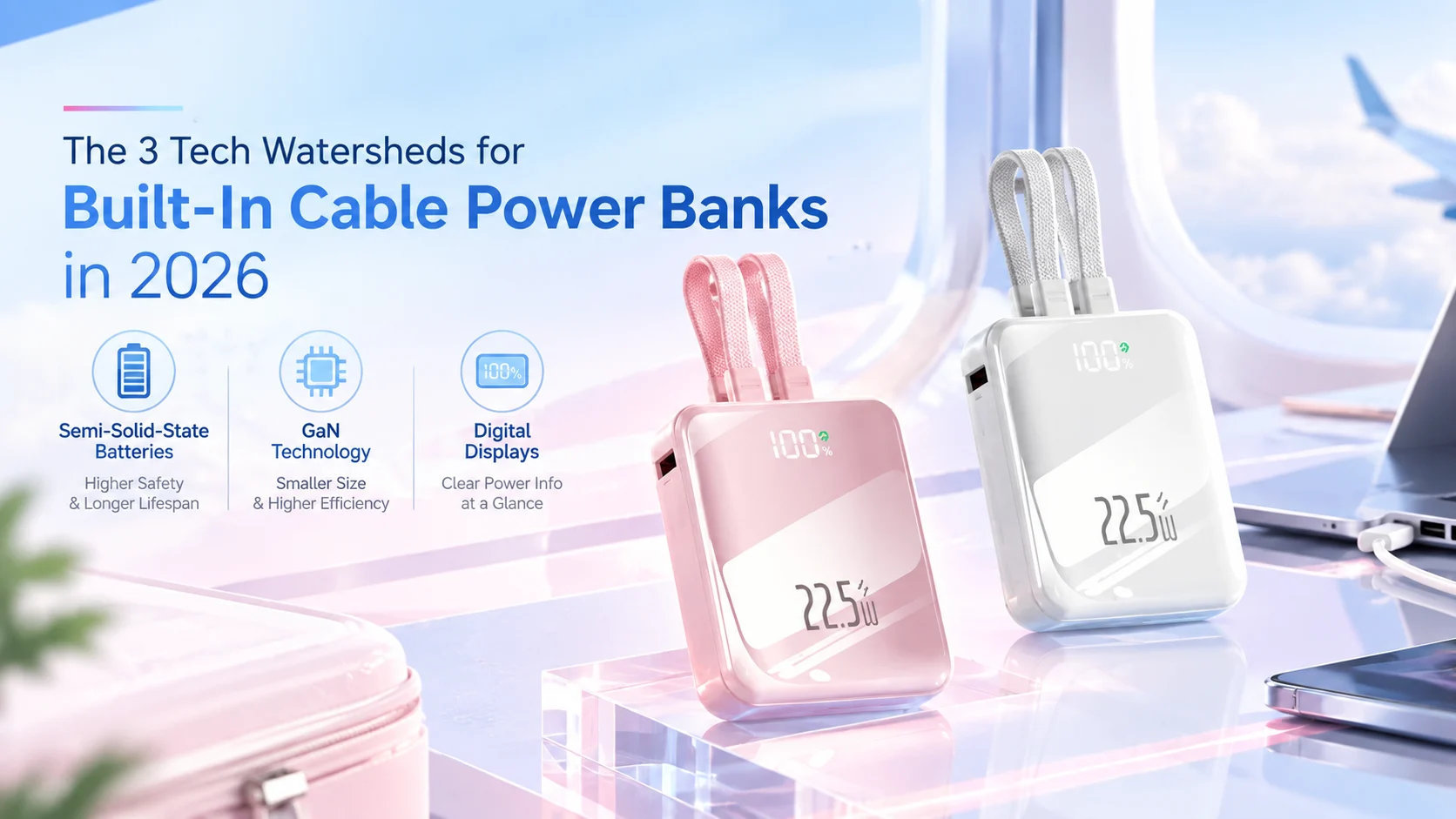
These technologies include GaN fast charging, semi-solid-state batteries, and precision digital displays.
Each upgrade addresses a different limitation of traditional power banks.
Together, they are reshaping the performance standards for modern portable charging products.
As a leading portable power bank supplier, AiL helps technical buyers evaluate these developments.
The following analysis focuses on their practical benefits and procurement value.
1. Three Technical Upgrades Shaping 2026 Power Bank Standards
GaN Technology: Higher Efficiency in a Smaller Form Factor
The first major upgrade focuses on power conversion efficiency and thermal management.
Traditional silicon components can generate more waste heat during high-power charging.
This can limit efficiency and make compact designs more difficult to achieve.
GaN, or Gallium Nitride, offers a more efficient alternative for power semiconductors.
GaN power semiconductors can increase conversion efficiency from 80%–85% to 90%–92%.
Higher efficiency means less energy is lost as waste heat.
Consequently, internal components can be positioned more closely together.
This allows manufacturers to reduce housing volume without sacrificing power output.
For compact, high-wattage models, this improvement can justify a moderate price premium.
Semi-Solid-State Batteries: Safety, Lifespan, and Slimmer Designs
While GaN improves power conversion, battery technology determines energy storage performance.
Traditional lithium-ion batteries rely heavily on flammable liquid electrolytes.
Semi-solid-state technology instead replaces most liquid components with a stable polymer-gel matrix.
This structural change can improve safety during everyday use.
Gel-state electrolytes reduce volatile leakage risks and thermal runaway hazards.
These benefits become especially relevant when power banks face punctures or heavy drops.
Semi-solid-state cells can also extend overall battery lifespan.
Their rated lifespan reaches approximately 1,000–2,000 charge cycles.
This is roughly 2–3 times longer than conventional lithium-polymer batteries.
At the same time, higher energy density enables slimmer product designs.
Some designs can achieve ultra-thin profiles down to 6.8 mm.
This makes semi-solid-state cells suitable for pocket-friendly built-in cable power bank products.
Precision Digital Displays: From Basic Indicators to Exact Monitoring
Once charging performance and battery structure improve, user interaction becomes another differentiation point.
Traditional four-stage LED indicators only show approximate remaining capacity.
Each indicator typically represents a 25% increment.
For modern users, this level of information can feel insufficient.
A real-time digital display can instead show battery levels from 1% to 100%.
This gives users a more precise understanding of remaining capacity.
For B2B buyers, the benefit extends beyond convenience.
A digital display creates a clear and visible product differentiator.
It can strengthen perceived product value across retail shelves and online storefronts.
2. Technical Comparison: Legacy Standards vs. 2026 Upgrades
The three technologies address different performance requirements. However, cable integration also remains essential for everyday convenience. The following matrix compares these features from a sourcing perspective.
| Technology Feature | Legacy Standard (2022–2024) | 2026 Tech Watershed Standard | Primary Sourcing Advantage | Procurement Value Rating |
|---|---|---|---|---|
| Power Semiconductor Core | Traditional Silicon (Si) | Gallium Nitride (GaN) | Higher efficiency (90%–92%), reduced heat and size | High ROI (Worth moderate premium) |
| Cell Chemistry & Structure | Liquid Lithium-Polymer | Semi-Solid-State Gel Battery | 1,000–2,000 cycles, ultra-thin (6.8 mm), non-flammable | Premium Segment (Highest safety and lifespan) |
| Charge Indicator Type | 4-LED Dot Lights (25% increments) | Real-Time LED/LCD Digital Display (1% precision) | Reduces user power anxiety and improves modern aesthetics | High Differentiator (Low cost, high impact) |
| Cable Integration | External loose cables | Built-In Reinforced Cables (Type-C / Lightning) | Plug-and-go convenience and zero cable clutter | Essential Standard for Everyday Carry |
These specifications should not be evaluated in isolation. Instead, procurement teams should consider how each upgrade supports the target product segment. This makes technology selection more closely connected to market positioning and expected margins.
3. Sourcing Strategy for Built-In Cable Power Bank Buyers
For B2B buyers, the next step is turning technical improvements into portfolio decisions. A diversified product lineup can address different consumer segments and price levels.
Position Premium Products With Semi-Solid-State Cells
Semi-solid-state models can support premium positioning. Their ultra-thin 6.8 mm profiles suit business travelers and luxury retail markets. Safety, lifespan, and sleek design can support higher-value product positioning.
Standardize GaN for Fast-Charging Models
GaN architecture is particularly valuable for high-output charging products. Buyers should consider GaN components for 30W–65W+ multi-device power banks. Higher efficiency helps maintain compact dimensions and manage heat during fast charging.
Transition From Four-LED Indicators
Basic four-LED indicators are becoming less competitive in premium product categories. Therefore, mid-tier and flagship models can transition toward 1% digital displays. This upgrade improves information accuracy and can strengthen perceived product value.
4. Why These Technologies Matter for Product ROI
The value of a new technology depends on its ability to solve a real user problem. GaN addresses efficiency, heat, and compact product design. Semi-solid-state batteries address safety, lifespan, and ultra-thin form factors. Digital displays address battery visibility and everyday user convenience.
Built-in cables address another common problem: cable clutter and forgotten charging cables.
Together, these features create a more convenient portable charging experience.
For B2B buyers, they also provide clear opportunities for product segmentation and differentiation.
5. The AiL Manufacturing Advantage
At AiL, we develop high-reliability charging solutions for global brands, electronics distributors, and OEM/ODM partners.
Advanced Cell Integration
AiL offers configurations ranging from ultra-thin semi-solid-state cells to high-density lithium-polymer options.
These battery configurations meet global safety standards, including UL, CE, RoHS, and UN38.3.
GaN Fast-Charging Expertise
AiL engineering teams integrate high-efficiency GaN circuits into compact housing designs.
These products can also incorporate durable built-in fast-charging cables.
This combination supports compact designs without sacrificing high-output charging performance.
Custom OEM/ODM Branding
AiL provides comprehensive customization for global B2B customers.
Services include digital display interface styling and housing surface finishes.
Customers can also customize cable lengths and retail packaging.
This flexibility allows brands to align product specifications with their target markets.
It also supports different positioning across standard, premium, and flagship product lines.
Conclusion: Upgrade Your Portable Power Catalog With AiL
The difference between a genuine innovation and a marketing gimmick lies in practical value.
For modern power banks, meaningful upgrades should improve performance, safety, convenience, or product differentiation.
GaN fast charging improves efficiency and supports smaller high-power designs.
Semi-solid-state batteries improve safety, lifespan, and ultra-thin product development.
Precision digital displays provide more accurate battery information for everyday users.
Built-in cables add convenient plug-and-go functionality without external cable clutter.
For B2B buyers, combining these technologies can create stronger and more competitive product portfolios.
The right configuration should ultimately match the target market, price segment, and usage scenario.
Partner with AiL, your trusted portable power bank supplier, for next-generation charging solutions.
Contact the AiL sales and engineering team for product samples and technical specifications.
You can also request custom OEM/ODM manufacturing quotes for your next product lineup.