The Misconceptions Surrounding Magnetic Wireless Charging
As magnetic wireless power banks (commonly associated with Apple’s MagSafe and Qi2 ecosystems) become staple accessories for smartphone users, concerns regarding long-term battery degradation have surged in buyer search trends. End-users and procurement teams frequently ask: Does using a magnetic power bank accelerate battery capacity loss compared to traditional wired charging?
The short answer is no—a certified, properly engineered magnetic power bank will not directly damage your smartphone battery. Modern smartphones, including iPhones and flagship Android devices, feature sophisticated internal Battery Management Systems (BMS) that actively regulate charging currents, voltage, and thermal thresholds.
However, battery health issues often arise from low-quality power banks that lack precise power delivery and heat dissipation engineering. Unregulated current conversion generates excessive, prolonged ambient heat, which is the primary catalyst for lithium-ion cell degradation. Understanding the physics of inductive power transfer and thermal control parameters is essential for sourcing high-performing, safe portable power solutions.
1. Inductive Charging Physics: Why Heat Generation Occurs
Wireless charging operates via electromagnetic induction. A transmitter coil inside the magnetic wireless power bank creates an alternating magnetic field, which induces an electrical current in the receiver coil inside the smartphone.
[Power Bank Internal Battery] ➔ [Transmitter Coil] ──(Electromagnetic Field)──► [Phone Receiver Coil] ➔ [Phone BMS / Battery]
                                       │
                                       ▼
                       Thermal Loss (~20-30% Efficiency Gap)
Because inductive coupling is less efficient than direct copper-wire transmission, approximately 20% to 30% of the input energy is converted into heat energy. This thermal output is a normal physical reaction. High-quality magnetic chargers mitigate heat buildup by isolating thermal zones, directing excess temperature away from the phone’s internal lithium-ion battery.
2. Technical Q&A: Evaluating Thermal Limits, Battery Health, and Charger Quality
Q: Is Wireless Charging Inherently Worse for Battery Health Than Wired Charging?
Technically, no. Degradation in modern lithium-ion batteries is driven by two main factors: high operating temperatures (above 35℃ / 95℉) and high state-of-charge exposure (holding 100\% charge for extended periods).
While a wired connection delivers higher energy efficiency with minimal ambient heat, a well-ventilated magnetic power bank operating within normal thermal ranges causes no significantly higher battery wear than fast wired charging.
The structural risk comes from uncertified third-party chargers that lack dynamic thermal throttling, causing the phone and charger assembly to stay at elevated temperatures for hours.
Q: What Temperature Range Is Considered “Normal” During Magnetic Charging?
During active magnetic wireless charging, operating surface temperatures generally fall into three distinct operational zones:
| Operating Temperature Range | Charging State & Thermal Profile | Safety & Battery Impact Level |
| Below 35℃ (95℉) | Standard ambient charging state; optimal energy conversion. | Ideal operating zone; zero accelerated degradation. |
| 35℃ – 40℃ (95℉ – 104℉) | Warm to the touch; normal under fast wireless or MagSafe modes. | Safe zone; monitored automatically by the smartphone BMS. |
| Above 40℃ ($104℉) | Overheating zone; caused by high ambient temps or poor thermal design. | Warning zone; triggers thermal throttling and battery strain. |
If a phone reaches 40℃ (104℉), the smartphone’s internal software automatically steps down the charging speed or pauses charging completely until the device cools down.
Q: How Can Buyers Identify High-Quality Thermal Control Engineering in a Magnetic Power Bank?
When evaluating custom or OEM portable power devices, procurement teams and brand managers should verify three critical hardware-level safety features:
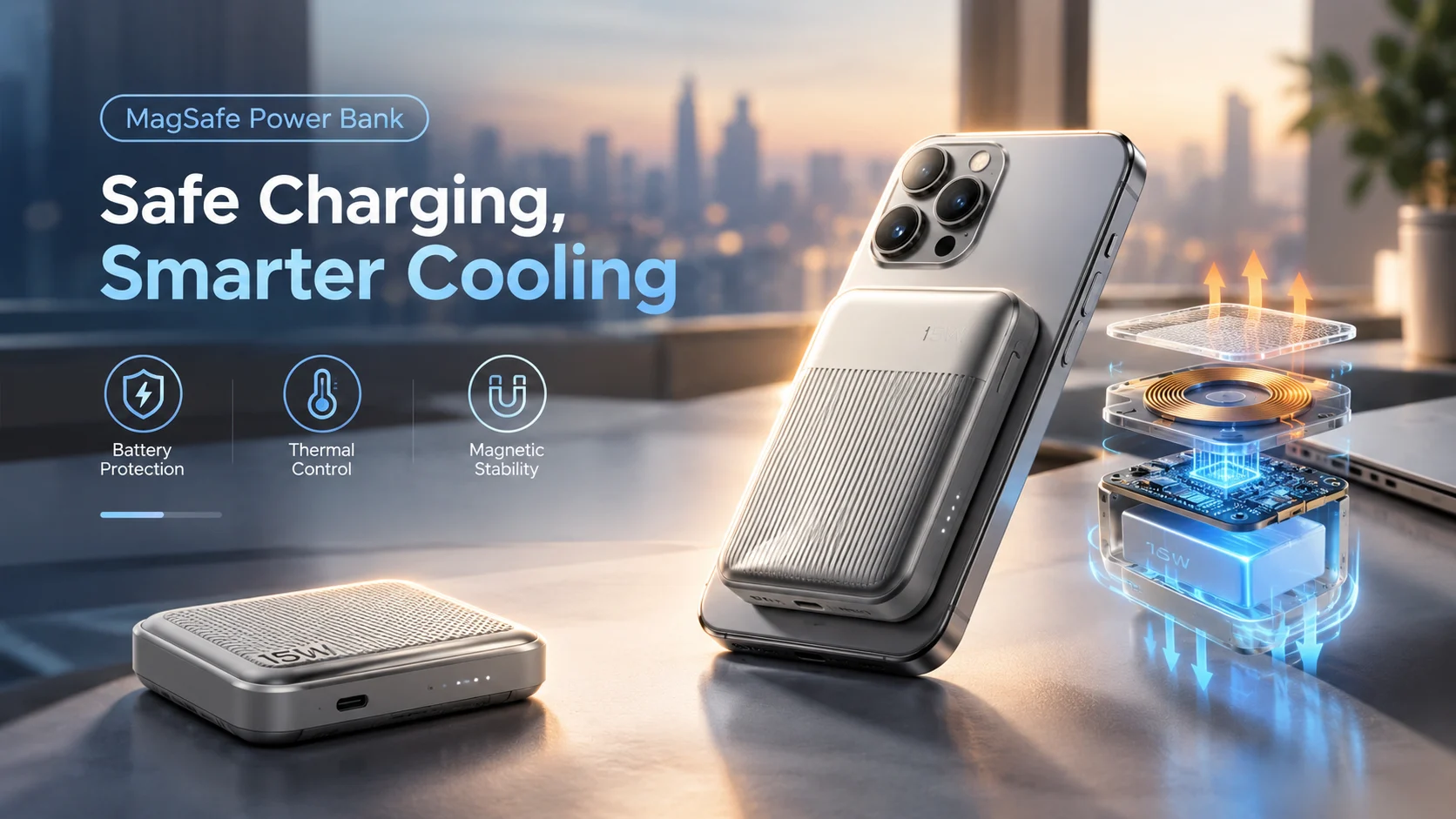
- Integrated NTC Thermistor Protection: High-grade power banks incorporate Negative Temperature Coefficient (NTC) sensors directly adjacent to the inductive coil and battery cells. These sensors monitor temperatures in real time (up to 100 times per second), automatically throttling output power if internal heat exceeds 40℃.
- Thermal Isolation & Heat-Sink Architecture: Premium designs isolate the PCB controller board from the power bank’s lithium-polymer cell, using graphite thermal sheets, aluminum alloy heat sinks, or aerogel insulation to push heat outward through the power bank’s exterior casing rather than into the back of the connected phone.
- Foreign Object Detection (FOD): Advanced FOD circuitry detects metal objects (such as keys, coins, or magnetic metal plates) trapped between the charger and phone, shutting down power instantly to prevent inductive overheating.
Technical Knowledge Summary
The claim that a magnetic power bank inherently destroys phone batteries is a misconception. While inductive power transfer produces heat as a byproduct of electromagnetic efficiency loss, smartphone protection algorithms and power bank thermal engineering keep temperatures within safe limits.
Battery degradation is driven by sustained thermal exposure above 40℃, not by magnetic alignment itself. High-performance portable power designs incorporate NTC thermal sensors, foreign object detection (FOD), structural heat shielding, and optimized coil coupling to dissipate heat away from the smartphone, ensuring safe power delivery and long-term battery protection.
Partner with Portable Power Specialists
Looking to engineer safe, high-performance portable charging solutions for your target market? Contact our technical engineering team with your product specifications, target market standards, and volume requirements to receive tailored thermal design consultations, sample evaluation units, and custom manufacturing quotes.