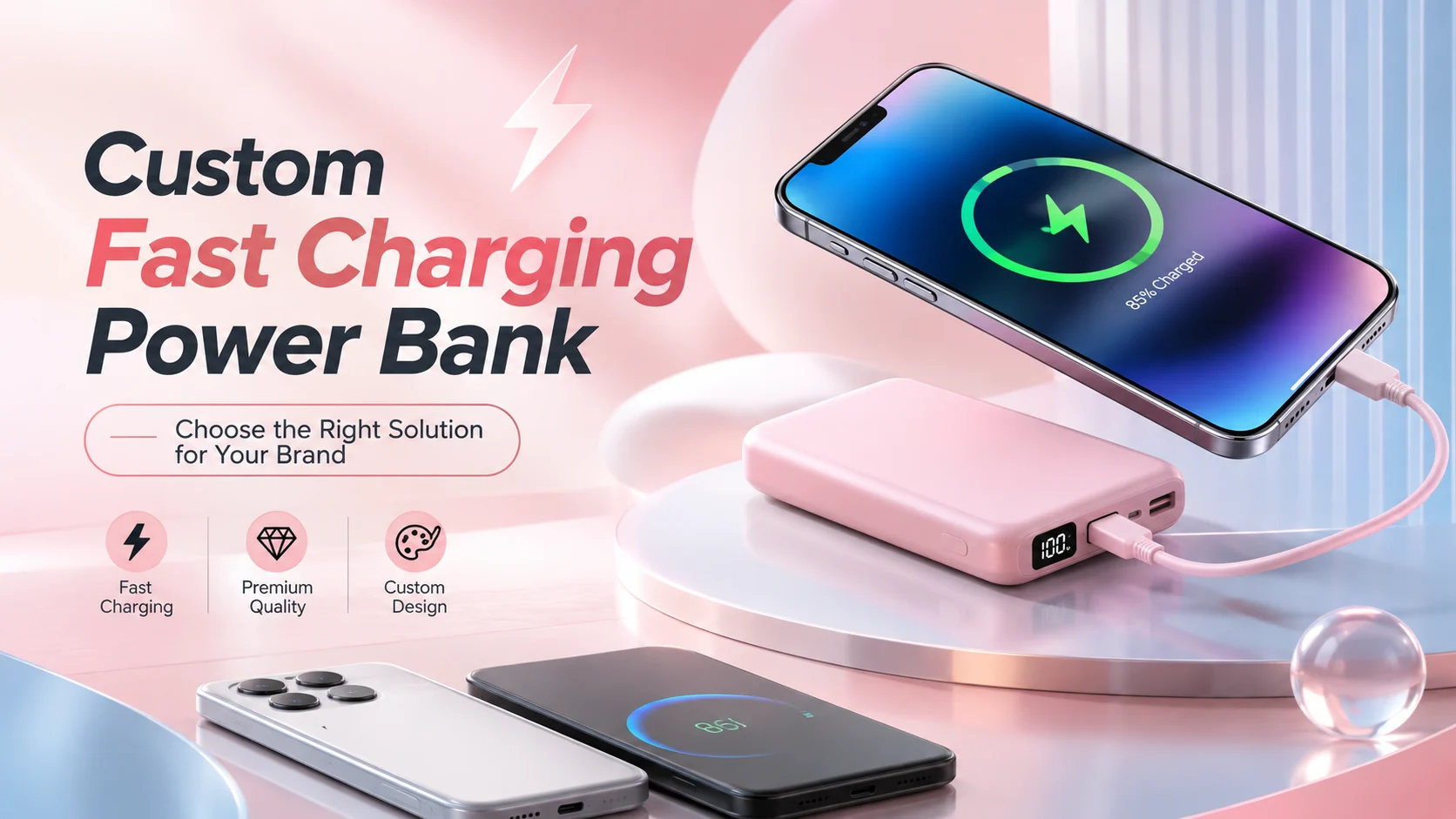
Choosing a custom fast charging power bank requires more than selecting a high output wattage. Brands must consider charging protocols, target devices, battery capacity, port configuration, thermal management, and market positioning. A 20W model may suit smartphone users, while a 65W or 100W model may target laptops and professional users.
However, higher wattage does not automatically mean better product performance. Charging speed depends on protocol compatibility, device requirements, cable specifications, battery conditions, and temperature control. A power bank that lacks the right charging protocol may not deliver its advertised maximum output to certain devices.
For brand owners, importers, distributors, and OEM buyers, the best approach is to define the target market before confirming product specifications. This guide explains how to evaluate fast charging protocols, choose suitable power levels, and manage heat in customized portable chargers.
1. The Fast Charging Revolution: What End-Users Demand
Fast charging has become an important purchasing factor for smartphone and laptop accessories. Users expect shorter charging times, broader device compatibility, and reliable performance during daily use.
For brands, these expectations create opportunities to develop differentiated fast charging power banks.
1.1 Why Users Need Faster Portable Charging
Traditional low-power power banks may not meet the needs of users with newer smartphones, tablets, and USB-C laptops.
Common user expectations include:
- Charging smartphones quickly during travel or commuting.
- Supporting tablets and other mobile devices.
- Providing emergency power for USB-C laptops.
- Charging multiple devices simultaneously.
- Maintaining stable output during extended use.
- Offering compact designs without compromising usability.
These requirements vary by customer group.
For example, smartphone users may prioritize portability and charging convenience. Business travelers may prefer higher output power and multiple USB-C ports. Outdoor users may value capacity, durability, and reliable temperature protection.
1.2 Charging Speed Is Not Determined by Wattage Alone
A power bank’s rated output describes its maximum available power under specified conditions. It does not guarantee that every connected device will receive that amount.
Actual charging performance depends on several factors:
| Factor | Effect on charging performance |
|---|---|
| Output wattage | Defines the maximum available power |
| Charging protocol | Enables compatible devices to negotiate charging conditions |
| Device compatibility | Determines the power the device can accept |
| Cable capability | Limits supported current and power |
| Battery state | Charging speed may decrease as the battery approaches full capacity |
| Temperature | Protection systems may reduce output when temperatures rise |
| Multi-port usage | Shared power may reduce the output available to each device |
Brands should avoid using maximum wattage as the only performance claim.
A complete product specification should explain supported protocols, individual port output, combined output, and operating conditions.
1.3 What Brands Should Consider Before Product Development
Before choosing a fast charging power bank configuration, buyers should identify the intended customer group.
| Target market | Main purchasing priorities | Potential product direction |
|---|---|---|
| Smartphone users | Compact size, convenient charging, broad compatibility | 20W–30W |
| Tablet users | Higher output and suitable capacity | 30W–45W |
| Business travelers | Laptop charging, multiple ports, portability | 65W |
| Professional users | Higher output, multi-device charging, larger capacity | 100W or above |
| Promotional gift market | Cost, branding, practical compatibility | 20W–30W |
These are product positioning suggestions, not universal device requirements. The final power configuration should match the target devices and competitive market.
2. Mainstream Fast Charging Protocols Explained: PD, QC, and PPS
Charging protocols determine how a power bank and connected device communicate to establish suitable charging conditions.
A custom fast charging power bank should support the protocols that matter to its target market.
However, protocol support must be verified at the product level. A general claim such as fast charging compatible does not confirm compatibility with every smartphone brand.
2.1 USB Power Delivery (USB PD)
USB Power Delivery, commonly called USB PD, is a charging protocol designed for USB devices.
It supports negotiated power delivery through compatible USB connections. Depending on the specification version and product implementation, it can support a wide range of output power levels.
USB PD is particularly important for:
- USB-C smartphones.
- Tablets.
- USB-C laptops.
- Portable monitors.
- Other compatible USB-C electronics.
For power bank development, buyers should confirm:
- Supported USB PD version.
- Available output voltage and current profiles.
- Maximum output power per port.
- Whether the product supports USB PD input and output.
- Compatibility with the intended devices.
USB PD support does not automatically mean a power bank can charge every USB-C laptop at its maximum speed.
2.2 Programmable Power Supply (PPS)
PPS is an optional feature within USB Power Delivery.
It allows compatible chargers and devices to negotiate adjustable voltage and current within supported operating ranges.
This flexibility can help compatible devices manage charging conditions more precisely.
PPS is relevant for brands targeting smartphone users who rely on compatible USB PD PPS charging systems.
When specifying PPS, buyers should confirm the actual voltage and current adjustment range. A product should not claim PPS support simply because it supports standard USB PD.
2.3 Qualcomm Quick Charge (QC)
Qualcomm Quick Charge is a fast charging technology used in compatible devices and accessories.
Different Quick Charge generations have different technical capabilities. Compatibility depends on the specific protocol version and the implementation in both the power source and receiving device.
For power bank buyers, important questions include:
- Which QC generation does the product support?
- Which output ports support QC?
- Does the product also support USB PD?
- Are there any restrictions when multiple ports operate simultaneously?
Brands should request a protocol compatibility report or a verified device test list before using broad compatibility claims.
2.4 Proprietary Charging Protocols: FCP and SCP
Some smartphone manufacturers use additional fast charging technologies.
Huawei’s FCP and SCP are examples of proprietary charging protocols associated with its device ecosystem.
Their charging behavior depends on device generation, protocol implementation, charger capability, and cable requirements.
A power bank that supports USB PD or QC may still fail to deliver a particular Huawei device’s advertised proprietary fast charging rate.
For brands targeting multiple smartphone ecosystems, protocol coverage should be based on actual customer demand and product validation.
2.5 Comparing Mainstream Charging Protocols
| Protocol | Main function | Buyer consideration |
|---|---|---|
| USB PD | Negotiated power delivery through compatible USB connections | Important for USB-C devices and laptops |
| PPS | Adjustable voltage and current within supported USB PD operation | Relevant to compatible smartphone fast charging |
| Qualcomm QC | Fast charging technology for compatible devices | Check generation and device compatibility |
| Huawei FCP/SCP | Proprietary fast charging technologies | Confirm support for target device models |
The most suitable combination depends on the intended market.
For international brands, USB PD is often a practical foundation for USB-C product compatibility. Additional protocols should be selected according to the target device ecosystem.
2.6 How to Verify Protocol Compatibility Before Ordering
Do not rely only on the protocol names printed on a product specification.
Ask the manufacturer for:
- Supported protocol versions.
- Output voltage and current profiles.
- Port-level protocol support.
- Multi-port output behavior.
- Compatible device test results.
- Cable requirements.
- Thermal performance under high-power operation.
A practical compatibility matrix should include the actual smartphone, tablet, and laptop models important to the target market.
3. Matching Wattage to Target Devices: 20W Smartphones vs. 65W Laptops
Power output is one of the most visible specifications in fast charging power bank marketing.
However, brands should select wattage according to the intended devices and user scenarios rather than simply choosing the highest available rating.
3.1 20W Power Banks for Everyday Smartphone Charging
A 20W fast charging power bank can serve users who primarily charge smartphones.
Potential advantages include:
- More compact power management requirements.
- Suitable output for many compatible smartphones.
- Practical positioning for everyday carry.
- Competitive product cost, depending on capacity and design.
For brands targeting general consumers, promotional products, and retail accessories, 20W can be a practical starting point.
However, not all smartphones support 20W USB PD charging. Actual output depends on device compatibility and charging conditions.
3.2 30W Power Banks for Broader Device Applications
A 30W power bank offers more output flexibility for compatible smartphones and selected tablets.
It may suit:
- Users with higher-power smartphones.
- Tablet owners.
- Business travelers.
- Consumers who charge multiple device types.
Compared with a 20W model, a 30W design may require different power management components and thermal considerations.
Brands should also evaluate whether the additional output creates meaningful value for their target users.
3.3 65W Power Banks for USB-C Laptop Charging
A 65W power bank is commonly considered for compatible USB-C laptops and higher-power mobile devices.
Potential applications include:
- Business laptops.
- Portable workstations with compatible charging input.
- Tablets with higher power requirements.
- Multi-device travel charging.
However, laptop charging compatibility depends on more than the 65W rating.
Buyers should confirm:
- USB PD output profiles.
- Laptop input power requirements.
- USB-C cable power rating.
- Battery capacity and usable energy.
- Whether the laptop can charge while operating.
A laptop that requires more than 65W may charge slowly, maintain its battery level, or continue discharging under heavy workloads.
3.4 100W Power Banks for Professional and Multi-Device Users
A 100W power bank can target users with higher charging demands.
Typical applications include:
- Compatible high-performance laptops.
- Professional mobile workstations.
- Multiple USB-C devices.
- Travel and field work.
- High-power portable electronics.
A 100W design may require more advanced power management, suitable battery configurations, higher-rated connectors, and more demanding thermal validation.
It may also increase product size, weight, and cost.
Brands should confirm whether their target customers genuinely need 100W output before selecting this configuration.
3.5 Comparing 20W, 30W, 65W, and 100W Models
| Rated output | Typical target users | Product positioning | Main design consideration |
|---|---|---|---|
| 20W | Smartphone users | Everyday portable charging | Compact design and protocol compatibility |
| 30W | Smartphone and tablet users | Versatile daily charging | Balanced power and portability |
| 65W | Laptop and tablet users | Business and travel charging | USB PD profiles and thermal design |
| 100W | Professional and multi-device users | High-power portable charging | Battery configuration, connectors, and heat management |
These wattage categories are not universal device compatibility guarantees.
3.6 Power Bank Capacity and Output Power Are Different
Buyers often confuse battery capacity with charging output.
Capacity is usually expressed in mAh or Wh. Output power is expressed in watts.
For example, a power bank may have a 20,000mAh battery capacity and a 65W maximum output. These specifications describe different characteristics.
For accurate product comparisons, Wh is particularly useful because it expresses stored energy.
A simplified relationship is:
Energy (Wh) = Voltage (V) × Capacity (Ah)
A battery rated at 20,000mAh and a nominal voltage of 3.7V contains approximately 74Wh of nominal energy.
Actual usable output energy will be lower because of conversion losses, battery operating limits, and other system factors.
Brands should specify nominal battery capacity and avoid presenting it as the exact energy delivered to connected devices.
3.7 Multi-Port Power Allocation
Multi-port fast charging power banks require careful output allocation.
For example, a power bank may advertise a maximum total output of 100W. This does not necessarily mean every port can deliver 100W simultaneously.
A product specification should clearly distinguish:
- Maximum USB-C1 output.
- Maximum USB-C2 output.
- USB-A output.
- Combined output when two ports operate.
- Combined output when all ports operate.
- Power allocation behavior when devices connect or disconnect.
A clear power distribution table helps buyers avoid misleading product claims.
4. Thermal Management and Safety Controls in Fast Charging
Fast charging increases power transfer and can create additional heat within the power bank.
Heat may come from battery cells, power conversion components, connectors, and circuit resistance.
A well-designed custom fast charging power bank must manage these heat sources without compromising charging performance or user safety.
4.1 Why Fast Charging Generates Heat
Power conversion is not perfectly efficient.
Some electrical energy becomes heat during charging and discharging. Higher current can also increase resistive losses in conductors and electronic components.
Temperature may rise due to:
- High charging or discharging power.
- Battery internal resistance.
- DC-DC conversion losses.
- High ambient temperature.
- Restricted ventilation.
- Simultaneous multi-port operation.
- Poor thermal contact between components.
The product’s temperature profile depends on its complete electrical and mechanical design.
4.2 NTC Temperature Sensors and Battery Monitoring
NTC thermistors are commonly used for temperature monitoring.
Their resistance changes with temperature, allowing the battery management system or power management circuitry to monitor thermal conditions.
Depending on the design, temperature sensors may be positioned near:
- Battery cells.
- Charging power components.
- Discharging power components.
- Other heat-sensitive areas.
The protection system can respond to temperature conditions through actions such as reducing charging current, limiting output power, or stopping operation.
However, the number and placement of sensors should be determined by the battery configuration and product safety design.
A single temperature sensor does not guarantee complete thermal protection.
4.3 Intelligent Power Allocation
Multi-port power banks need to manage output power according to connected devices and internal operating conditions.
An intelligent power management system may:
- Detect connected devices.
- Negotiate supported charging protocols.
- Allocate available output power.
- Monitor voltage and current.
- Track temperature conditions.
- Adjust output when protection limits are reached.
For example, a 100W power bank may reduce the power available to one port when another device is connected.
The exact allocation strategy should be documented in the product specification.
4.4 Thermal Design and Component Selection
Thermal management should be considered during product development rather than added after the prototype is complete.
Important design factors include:
| Design factor | Function |
|---|---|
| Battery cell selection | Influences internal resistance and thermal behavior |
| Power management IC | Controls voltage conversion and charging behavior |
| PCB layout | Affects current paths and heat distribution |
| Thermal interface materials | Improve heat transfer between selected components |
| Enclosure material | Influences structural design and heat transfer |
| Temperature sensors | Monitor important thermal locations |
| Firmware protection | Controls output under defined abnormal conditions |
The enclosure should also provide adequate space for the battery, PCB, insulation, and thermal components.
For compact products, thermal design requires careful coordination between electrical and mechanical engineers.
4.5 Safety Protection for Fast Charging Power Banks
Fast charging power banks should incorporate protection functions appropriate to their battery chemistry, electrical architecture, and applicable product safety requirements.
Common protection considerations include:
- Overcharge protection.
- Over-discharge protection.
- Overcurrent protection.
- Short-circuit protection.
- Overvoltage protection.
- Overtemperature protection.
- Battery cell monitoring.
- Input and output abnormal-condition protection.
The exact protection architecture varies by design.
For international sales, buyers should also confirm applicable battery and product safety requirements in the destination markets. Relevant testing and certification may include requirements for portable lithium batteries, transportation, and electrical product safety.
For example, UN 38.3 concerns the testing of lithium cells and batteries for transport. It should not be described as a general consumer product safety certification.
4.6 Thermal Validation Before Mass Production
A prototype should undergo thermal testing under representative operating conditions.
A practical test plan may include:
- Maximum rated output operation.
- Charging at the specified input power.
- Simultaneous multi-port operation.
- High ambient temperature testing.
- Repeated charging and discharging.
- Temperature monitoring at battery and power components.
- Verification of thermal protection behavior.
Test conditions should be documented, including ambient temperature, cable type, device load, operating duration, and measurement locations.
This helps brands evaluate thermal performance consistently and identify potential design improvements before mass production.
5. How to Customize a Fast Charging Power Bank for Your Brand
After selecting the target power level and protocol combination, buyers should define the complete product configuration.
5.1 Confirm the Core Product Specifications
Before requesting a quotation, prepare the following information:
| Specification | Information to confirm |
|---|---|
| Battery capacity | Target mAh or Wh |
| Maximum output | 20W, 30W, 65W, 100W, or other |
| Charging protocols | USB PD, PPS, QC, or required proprietary protocols |
| Input power | Maximum supported charging input |
| Port configuration | USB-C, USB-A, or multiple ports |
| Combined output | Power distribution across ports |
| Battery chemistry | Selected cell type and configuration |
| Display | LED indicators or digital display |
| Enclosure | Material, dimensions, and surface finish |
| Branding | Logo, color, packaging, and custom design |
| Safety requirements | Applicable market standards and testing |
5.2 Review Sample Performance
Before approving mass production, brands should evaluate more than appearance.
A sample validation checklist may include:
- Charging protocol negotiation.
- Output voltage and current.
- Maximum output power.
- Multi-port power distribution.
- Charging efficiency.
- Temperature rise.
- Protection function verification.
- Battery capacity verification.
- Connector durability.
- Enclosure fit and finish.
Testing should use compatible devices and cables that represent the intended market.
5.3 Evaluate the Supplier’s Engineering Capabilities
A suitable OEM supplier should understand the relationship between battery configuration, power management, charging protocols, and thermal design.
During supplier evaluation, buyers can ask about:
- Protocol implementation and verification.
- Battery and power management design.
- Multi-port power allocation.
- Thermal monitoring and protection.
- Prototype development.
- Product validation procedures.
- Production quality control.
- Documentation for target markets.
A technically complete specification makes supplier comparisons more meaningful than price alone.
6. Frequently Asked Questions
Q1: What wattage should I choose for a custom fast charging power bank?
20W and 30W models are common options for smartphone and tablet users. A 65W model may suit compatible USB-C laptops, while 100W targets higher-power devices. The best choice depends on target devices, market demand, capacity, and product size.
Q2: Is USB PD better than Qualcomm Quick Charge?
They serve different compatibility requirements. USB PD is important for many USB-C devices, while Quick Charge supports compatible devices within its protocol ecosystem. Brands should select protocols according to their target customer devices rather than assuming one is universally better.
Q3: Does PPS make a power bank charge every smartphone faster?
No. PPS requires compatible support from both the power source and the receiving device. Actual charging speed also depends on device settings, battery conditions, and cable compatibility.
Q4: Can a 65W power bank charge a laptop?
Yes, if the laptop supports compatible USB-C charging and accepts the power bank’s available output profiles. A laptop requiring more than 65W may charge slowly or may not maintain its battery level during demanding operation.
Q5: Does higher wattage always produce more heat?
Higher power can increase heat generation, but actual temperature depends on conversion efficiency, current, component selection, thermal design, and operating conditions. A well-designed higher-power product may manage heat more effectively than a poorly designed lower-power product.
Q6: Why does a fast charging power bank reduce output when several devices are connected?
The power bank has a limited total power budget. Its internal power management system distributes available power among connected devices. Individual port output may decrease when multiple devices operate simultaneously.
Q7: What safety features should a custom fast charging power bank include?
The protection design should address overcharge, over-discharge, overcurrent, short circuit, overvoltage, and abnormal temperature conditions. The specific requirements depend on battery chemistry, circuit architecture, and destination-market regulations.
Conclusion: Match Charging Performance with Real Market Requirements
Choosing the right custom fast charging power bank requires a balance between charging protocols, output power, battery capacity, device compatibility, and thermal management.
USB PD provides an important foundation for many USB-C devices. PPS and Quick Charge can extend compatibility for selected device ecosystems. Proprietary protocols may be relevant when targeting specific smartphone markets.
Power ratings should reflect real user requirements. A 20W or 30W model may suit everyday smartphone users, while 65W and 100W models target compatible laptops and higher-power applications.
Most importantly, charging performance must be supported by appropriate battery management, temperature monitoring, protection functions, and product validation.
For brands developing customized portable chargers, a complete specification and verified sample provide the foundation for reliable mass production. AiL supplies custom power bank solutions for brand and OEM projects. Share your target market, charging requirements, and design preferences with our team to discuss a suitable product configuration.