
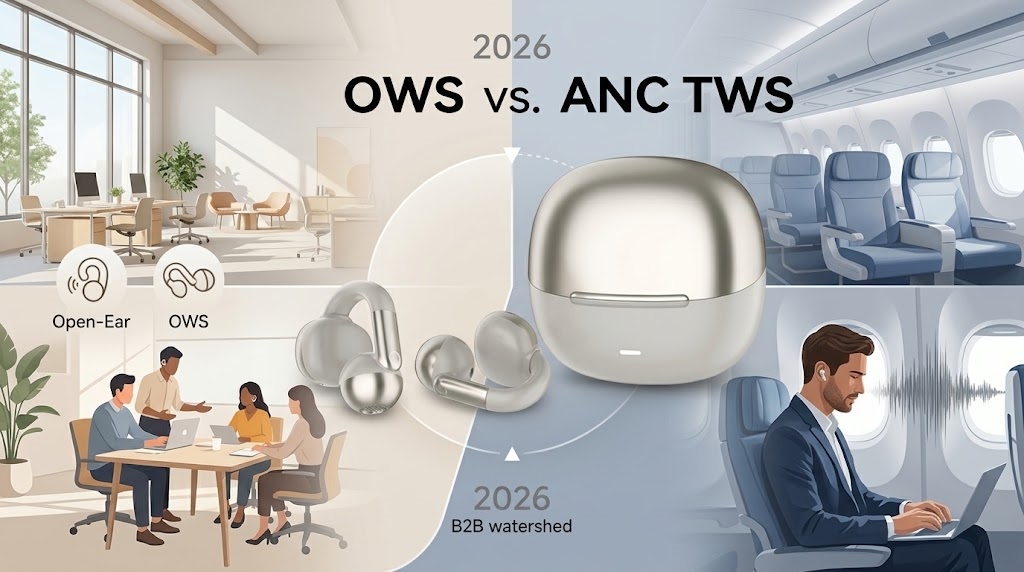
As the global wireless audio market continues to evolve in 2026, open-ear OWS headphones are becoming an increasingly important product category for electronics brands, distributors, and private-label sellers. Compared with traditional ANC TWS earbuds, open-ear audio focuses on a different combination of comfort, situational awareness, and multi-scenario usability.
For B2B buyers, the shift is particularly relevant because product demand is no longer driven only by noise cancellation. Instead, consumers increasingly expect headphones that can remain comfortable throughout the day while allowing them to stay aware of their surroundings.
Therefore, understanding the differences between OWS open-ear audio and traditional ANC TWS is essential when developing a competitive wireless audio product portfolio.
1. Market Structural Shift: OWS Open-Ear vs. Traditional ANC TWS
A direct comparison of functionality, acoustic design, and consumer applications helps explain why custom open ear headphones are attracting growing attention from distributors and consumer electronics brands.
| Market Feature | Open-Ear OWS Audio | Traditional ANC In-Ear TWS |
|---|---|---|
| Primary Value Proposition | All-day comfort and situational awareness | High isolation and noise suppression |
| Multi-Scenario Utility | High: office, sports, commuting, outdoors | Medium: flights, subways, quiet-focus environments |
| Ear Canal Pressure | Zero pressure with non-in-ear design | Higher pressure from silicone ear-tip insertion |
| Battery Performance | Extended playtime with larger battery capacity | Standard playtime, especially with ANC enabled |
| Acoustic Engineering | Directional sound and air conduction | Sealed dynamic or BA drivers |
| Market Growth Trend | Rapid growth, >60% YoY | Mature and increasingly saturated |
Single-Scenario Isolation vs. Multi-Scenario All-Day Comfort
Traditional ANC TWS earbuds generally rely on silicone ear tips inserted into the ear canal. This physical seal helps improve passive isolation and supports active noise cancellation. Consequently, ANC TWS remains particularly useful in environments such as subway trains, airplanes, and other noisy locations.
However, prolonged in-ear use can cause discomfort for some users. Ear fatigue, moisture accumulation, and pressure inside the ear canal can become concerns during extended listening.
By contrast, OWS open-ear headphones leave the ear canal open. As a result, users can hear ambient sounds naturally while still enjoying wireless audio. This combination makes open-ear headphones particularly suitable for people who listen to audio for several hours a day.
Versatility and Inventory Velocity
Beyond comfort, open-ear audio also offers an important advantage for B2B distributors: multi-scenario product positioning.
For example, one well-designed OWS headphone can target outdoor runners who need situational awareness, hybrid office workers who frequently take calls, and commuters who want music without missing station announcements.
Therefore, a high-performance custom open ear headphones supplier can help brands develop a product that addresses several consumer scenarios with a single core SKU. This can simplify product positioning while potentially improving inventory efficiency.
2. Acoustic Engineering and OEM Innovations in Custom Open-Ear Audio
Although early open-ear headphones faced challenges related to sound leakage and limited bass performance, modern acoustic engineering has significantly improved the category.
As a result, today’s custom open ear headphones can combine open-ear comfort with more focused sound transmission and enhanced low-frequency performance.
Directional Sound Transmission and Sound Leakage Control
One of the key engineering challenges in open-ear audio is delivering sufficient sound to the listener while minimizing leakage into the surrounding environment.
To address this challenge, leading custom open ear headphones suppliers use precise directional acoustic technologies. Phase-cancellation algorithms and reverse sound-wave arrays can help focus acoustic energy toward the auditory canal.
Consequently, directional sound transmission can improve listening privacy and reduce unwanted sound leakage. This is especially useful for office environments where users may need to participate in private voice calls without completely blocking surrounding sounds.
Large-Diaphragm Drivers and Air-Conduction Performance
Another important development is the use of larger dynamic drivers.
Traditional TWS earbuds commonly use relatively compact 6 mm–10 mm drivers. In comparison, modern open-ear audio products can utilize customized 14.2 mm–16.2 mm dynamic drivers with bio-fiber composite diaphragms.
Furthermore, manufacturers can combine larger drivers with bass-enhancement algorithms to compensate for some of the acoustic limitations associated with open-ear designs.
As a result, air-conduction OWS headphones can deliver stronger low-frequency performance while keeping the speaker outside the ear canal.
Ergonomic Weight Distribution and Durable Materials
Acoustic performance alone is not enough for an all-day wearable product. Therefore, ergonomic engineering is another important consideration when developing custom open ear headphones.
Premium OWS headsets can incorporate flexible titanium memory-wire frames covered with skin-friendly liquid silicone. This structure helps distribute the product’s weight around the outer ear rather than concentrating pressure inside the ear canal.
Consequently, the headphones can remain secure during workouts while also providing comfortable wear during extended workdays of up to 8 hours.
3. AiL Custom Headphones OEM/ODM Manufacturing Capabilities
For brands entering or expanding within the open-ear audio market, product differentiation depends not only on the hardware itself but also on acoustic tuning, industrial design, software integration, and certification.
AiL provides turnkey OEM/ODM headphone manufacturing solutions for global electronics brands, distributors, and private-label sellers.
Custom Acoustic Tuning and DSP Integration
AiL’s acoustic engineering capabilities support customized frequency curves, spatial-audio DSP algorithms, and dual-microphone ENC noise-cancellation systems.
Through these technologies, brands can develop differentiated sound profiles while improving voice clarity during calls.
Flexible Branding and Material Finishes
In addition to acoustic customization, brands can customize the appearance and user experience of their wireless headphones.
Available options include:
- Custom colorways
- UV metallic coatings
- Laser-engraved branding
- Custom retail packaging
- Proprietary app software integration
Therefore, buyers can develop a more complete private-label audio product rather than simply purchasing an off-the-shelf headphone.
Rigorous Quality Control and Compliance
For international B2B distribution, compliance is equally important. AiL follows certified production processes adhering to ISO9001 standards, while its products are designed to meet applicable CE, FCC, RoHS, and Bluetooth SIG requirements.
This combination of manufacturing control and compliance support helps brands prepare products for international markets more efficiently.
4. B2B Selection Matrix: How Channel Buyers Should Allocate Inventory
Because OWS open-ear audio and ANC TWS serve different consumer needs, channel buyers should evaluate both categories according to their target markets rather than treating them as direct substitutes.
For a diversified 2026 audio portfolio, the following allocation strategy can provide a practical reference:
| Product Category | Suggested Inventory Ratio | Target Consumer Persona | Key Sourcing Checkpoints |
|---|---|---|---|
| Open-Ear OWS Headphones | 55%–65% (High Growth) | Outdoor athletes, hybrid office workers, all-day listeners | Directional sound tuning, Bluetooth 5.4, multipoint pairing |
| ANC In-Ear TWS | 25%–35% (Core Base) | Frequent flyers, daily commuters, deep-focus users | Active noise reduction > -45 dB, transparency mode |
| Bone Conduction Sport Sets | 10%–15% (Niche/Active) | Swimmers, endurance athletes, heavy sports users | IP68 waterproof rating, onboard MP3 storage options |
This portfolio approach allows distributors to capture the growth of open-ear audio while maintaining established ANC TWS products for consumers who prioritize maximum noise isolation.
At the same time, bone-conduction products can continue serving specialized sports and waterproof applications.
Technical Summary
The transition from traditional in-ear TWS toward OWS open-ear audio reflects a broader change in consumer expectations. Instead of focusing exclusively on noise isolation, users increasingly value all-day comfort, situational awareness, flexible wearing scenarios, and wireless convenience.
For electronics brands and distributors, partnering with an experienced custom open ear headphones supplier can provide an effective route to developing differentiated products for this growing category.
By combining directional sound transmission, large-diaphragm air-conduction drivers, ergonomic non-in-ear construction, DSP tuning, and flexible OEM/ODM customization, open-ear headphones can address a wide range of consumer applications.
AiL manufactures custom open ear headphones, OWS open-ear audio products, and private-label wireless headphones, providing OEM/ODM solutions for global electronics brands, distributors, and B2B audio buyers.