
In the history of personal audio, we have spent decades obsessing over the “signal”—the bitrates, the driver diameters, and the frequency response curves. We have perfected the way sound travels through the air, but we have often neglected the final, most intimate millimetre: the physical interface where the machine meets the human body.
For too long, comfort was treated as a secondary, subjective byproduct of design, often relegated to generic rubbers and rigid plastics. However, a “Gentle Revolution” is currently unfolding at the intersection of audiology and material science. By adopting cutting-edge materials from the worlds of medical hearing aids and wearable healthcare devices, modern wireless Bluetooth earbuds are rewriting the physical and chemical relationship between technology and the ear canal. This is the story of how comfort is being transformed from a vague sensory description into an objective, scientifically optimised masterpiece.
1. The Biological Frontier: Why the Ear Canal is a Design Challenge
The human ear canal is one of the most sensitive and structurally complex areas of the body. It is not a static cylinder; it is a dynamic, living passage that changes shape when we speak, chew, or tilt our heads.
The Failure of “Universal” Plastics
Standard PVC or low-grade elastomers used in budget earbuds are fundamentally “hostile” to this environment.
The Pressure Paradox: To create an acoustic seal, rigid materials must exert outward pressure. In a dynamic ear canal, this constant force leads to “listener fatigue” and physical soreness within thirty minutes.
The Chemical Friction: Low-grade materials can trigger contact dermatitis or trap moisture, leading to bacterial growth. The “Gentle Revolution” recognises that to achieve true comfort, the earbud must stop trying to force the ear to adapt to the plastic, and instead, the material must adapt to the ear.
2. Medical-Grade Silicone: The “Liquid Gold” of Skin Contact
The first pillar of this material evolution is the migration of medical-grade silicone from the operating room to the audio studio. Originally developed for catheters and long-term hearing implants, this material represents the pinnacle of biocompatibility.
Hypoallergenic Purity
Unlike industrial rubbers, medical-grade silicone is chemically inert. It does not leach plasticisers or irritate the delicate epithelial lining of the ear. For users with sensitive skin, this is the difference between an itchy, uncomfortable experience and a “disappearing” sensation where the earbud feels like a natural extension of the body.
Surface Energy and “The Second Skin”
Scientists have optimised the surface energy of these silicones to mimic the texture of human skin.
Friction Management: By fine-tuning the coefficient of friction, engineers ensure the earbud stays secure during a workout without “gripping” the skin so tightly that it causes micro-abrasions.
Thermal Equilibrium: High-quality silicone reaches body temperature almost instantly, eliminating the “cold shock” of inserting a device on a winter morning.
3. Adaptive Memory Foam: The Physics of the Perfect Seal
While silicone provides the “skin,” adaptive memory foam provides the “skeleton.” This material, often derived from aerospace and prosthetic limb research, has transformed the acoustic seal into a personalised engineering feat.
The Temperature-Sensitive Transformation
Memory foam is a viscoelastic material. Its “magic” lies in its reaction to body heat.
Slow-Recovery Dynamics: When compressed and inserted, the foam doesn’t snap back like a spring. Instead, it uses the warmth of the ear canal to slowly expand, flowing into every unique ridge and contour of the individual’s ear.
The “Custom-Fit” Illusion: This creates a pressurised seal that is mathematically distributed across the entire surface area. By eliminating “hot spots” of pressure, memory foam allows for 8 to 10 hours of continuous wear without the slightest hint of discomfort.
Acoustic Insulation as a Material Property
Beyond comfort, adaptive foam serves a dual purpose. Its porous structure acts as a natural “low-pass filter” for external noise. By perfectly conforming to the ear canal, it provides passive noise isolation that rivals active electronic cancellation, all while maintaining a soft, pillowy touch.
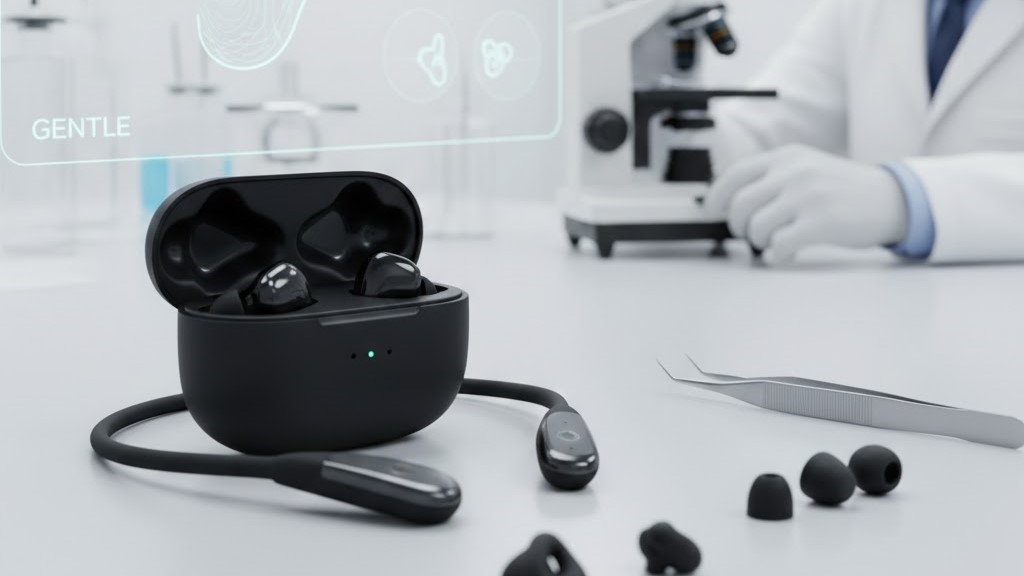
4. The “Dry-Tech” Revolution: Managing the Micro-Climate
One of the greatest enemies of long-term earbud wear is moisture. The ear canal is a humid environment, and sealing it off can create a “greenhouse effect.”
Oleophobic and Hydrophobic Coatings: The latest frontier in earbud materials involves nano-coatings that repel earwax (cerumen) and sweat. This isn’t just for hygiene; it ensures that the material properties—the softness and elasticity—do not degrade over time due to chemical exposure.
Breathable Membranes: Some high-end designs are experimenting with semi-permeable materials that allow air pressure to equalise between the inner ear and the outside world. This prevents the “clogged” or “underwater” feeling (occlusion effect) that many users find distressing.
5. Why Materials are the Ultimate Competitive Edge
For the manufacturer and the consumer, the shift toward premium materials is a strategic evolution.
Retention and Loyalty: In the saturated market of wireless Bluetooth earbuds, sound quality has reached a “plateau of excellence.” The next battlefield is wearability. A user will forgive a slightly imperfect EQ, but they will never forgive a device that causes pain.
Sustainability through Quality: Medical-grade materials and high-density foams last longer. They resist cracking, yellowing, and losing their shape, reducing the cycle of electronic waste.
Enhanced Audio Performance: A better material fit leads to a better acoustic seal. A better seal leads to better bass response and more effective noise cancellation. In this sense, material science is the “silent amplifier” of audio quality.
6. Conclusion: The Future is Soft
The “Gentle Revolution” reminds us that technology is at its best when it respects the human form. By looking toward the frontlines of medical science and polymer engineering, we are moving into an era where our devices no longer feel like “foreign objects.”
When you put on a pair of modern earbuds, you are experiencing the culmination of thousands of hours of laboratory research. You are feeling the “kiss” of materials that have been engineered to be as soft as a whisper and as adaptive as water. We have moved beyond the era of the “Universal Fit” and into the era of the “Personalized Embrace.” The future of audio is no longer just about what you hear; it is about how you feel. And as it turns out, the future is incredibly soft.