
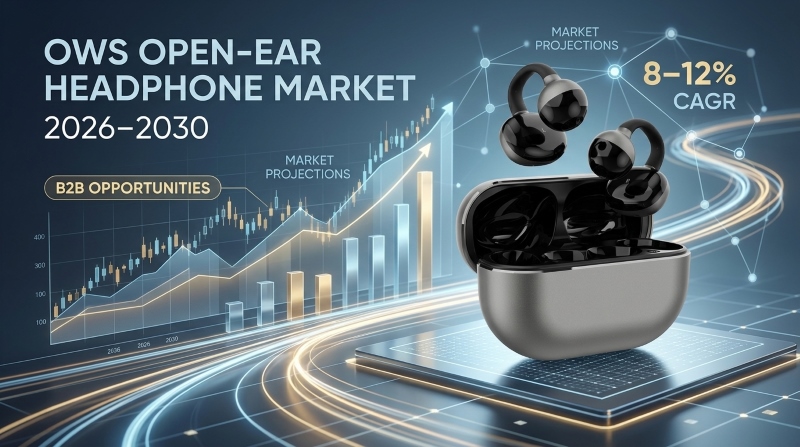
Global audio market research projects sustained momentum for Open-Wearable Stereo (OWS) technology. Analysts at 360iResearch project an 10.68% CAGR, reaching $4.16 billion by 2032, while Valuates forecasts an 8.3% CAGR, reaching $3.86 billion by 2031. This industry consensus confirms a robust 8–12% compound annual growth rate for the open-ear audio sector.
Crucially, this growth does not represent a simple replacement of traditional True Wireless Stereo (TWS) earbuds. Instead, OWS represents market expansion. Open-ear designs attract new user segments—including daily commuters, office professionals needing situational awareness, outdoor athletes, and hearing-sensitive consumers—who found traditional in-ear designs uncomfortable.
Understanding the market dynamics of custom OWS open-ear headphones allows audio brand strategists, supply chain directors, and OEM buyers to capture emerging market share.
1. Market Expansion vs. Product Replacement: Data-Driven B2B Opportunities
As the personal audio market continues to evolve, OWS open-ear headphones are creating new opportunities rather than simply replacing traditional TWS in-ear headphones. In particular, open-ear audio addresses user needs that conventional sealed earbuds cannot fully satisfy.
To understand this market shift, it is useful to compare the core differences between traditional TWS earbuds and OWS open-ear headphones:
| Market Metric | Traditional TWS In-Ear Headphones | OWS Open-Ear Headphones |
|---|---|---|
| Primary User Value | Active Noise Cancellation (ANC) | Situational Awareness & Safety |
| Physical Ergonomics | Ear canal occlusion (Sealed fit) | Off-ear / Non-occluding fit |
| Wear Fatigue | High after 2–3 hours of use | Ultra-low for all-day wearing |
| Target Demographics | Commuters, gamers, music purists | Athletes, office staff, seniors |
| Market Expansion | High saturation in mature markets | Rapid expansion across new TAM |
Therefore, the key opportunity for audio brands is not simply to replace TWS earbuds. Instead, OWS technology expands the total addressable market (TAM) by serving consumers who prioritize comfort, environmental awareness, and long-duration wear.
Capturing Untapped Consumer Segments
Traditional in-ear headphones use silicone or similar ear tips to create a sealed connection inside the ear canal. Although this design can provide strong passive isolation and support ANC performance, prolonged use may cause ear pressure, moisture accumulation, and physical discomfort for some users.
By contrast, OWS open-ear headphones keep the ear canal open. Depending on the product architecture, they transmit audio through air conduction or directional acoustic projection.
As a result, this design can serve a wider range of applications.
For example, office professionals can maintain ambient awareness during calls while remaining aware of colleagues and surrounding conversations. Similarly, runners, cyclists, and other athletes can listen to audio while maintaining greater awareness of environmental sounds.
Consequently, OWS products can target consumer segments that may not be fully addressed by traditional sealed-fit TWS products.
2. Core Technical Bottlenecks and Manufacturing Solutions in OWS Engineering
Although the market opportunity is significant, developing a competitive custom OWS open-ear headphone requires manufacturers to overcome several acoustic and mechanical challenges.
Because the driver operates outside the ear canal, engineers must balance sound projection, leakage, comfort, stability, and bass performance. Therefore, successful OWS development requires coordinated acoustic engineering and mechanical design.
Directional Sound Transmission and Sound Leakage Control
One of the most important challenges in OWS headphone manufacturing is controlling sound leakage.
Unlike conventional in-ear earbuds, open-ear drivers are positioned outside the ear canal. Therefore, acoustic energy can potentially radiate toward surrounding areas, creating privacy concerns in offices, public transportation, and other shared environments.
To address this issue, advanced OWS designs can incorporate directional acoustic projection, beamforming, and reverse sound-wave cancellation algorithms.
These technologies are designed to focus acoustic energy toward the user’s ear while reducing unnecessary lateral sound radiation.
As a result, manufacturers can improve listening privacy without sacrificing the fundamental open-ear design.
Ergonomic Weight Distribution and Clamping Force
In addition to acoustic performance, physical stability is another critical consideration.
Traditional TWS earbuds typically rely on the ear canal and ear tips for mechanical retention. In contrast, OWS headphones commonly use ear-hook structures, flexible neckbands, or other off-ear support mechanisms.
Therefore, the mechanical structure must provide sufficient stability without creating excessive pressure.
For sports-oriented products, for example, manufacturers can integrate high-elasticity memory titanium wires with skin-friendly liquid silicone. This combination helps maintain a secure fit while supporting extended wearing comfort.
At the same time, weight distribution should be carefully optimized so that the product remains stable during walking, running, or other physical activities.
Driver Calibration and Bass Compensation
Bass reproduction presents another important engineering challenge.
Because OWS headphones do not form a sealed acoustic chamber inside the ear canal, low-frequency energy naturally attenuates more quickly across open space. Consequently, simply using the same acoustic architecture as a traditional TWS earbud may result in insufficient bass response.
To compensate, custom OWS headphones can utilize larger dynamic driver diaphragms, typically ranging from 14 mm to 16.2 mm, together with dynamic bass-enhancement DSP tuning.
This approach allows engineers to improve perceived low-frequency performance while maintaining the open-ear acoustic architecture.
3. AiL Custom OWS Headphone Manufacturing and OEM/ODM Solutions
For audio brands entering the open-ear market, selecting an experienced OWS OEM/ODM manufacturer is essential. AiL provides integrated manufacturing services for custom OWS open-ear headphones, helping brands move from product concept and acoustic development to mass production.
Custom Acoustic Engineering and Driver Tuning
First, AiL supports customized acoustic development for different OWS product applications.
The company designs high-sensitivity dynamic acoustic drivers together with customized directional sound conduits. In addition, engineering teams can tune DSP frequency curves to compensate for low-frequency attenuation.
As a result, brands can pursue a richer bass response while maintaining controlled sound leakage in public environments.
This acoustic customization is particularly valuable for brands developing differentiated products rather than relying on generic OWS reference designs.
Advanced Ergonomic Materials and Rapid Prototyping
Mechanical comfort is equally important for long-duration open-ear products.
AiL utilizes bio-compatible liquid silicone, memory nitinol wire, and lightweight composite housings to develop ergonomic OWS structures.
Furthermore, customized product geometry can be developed according to different wearing preferences and target applications.
For outdoor and sports products, AiL can provide IPX5–IPX7 water-resistant open-ear structures, combining environmental protection with customized industrial design and fitting profiles.
Therefore, brands can develop products that are not only technically functional but also aligned with their specific CMF and product positioning requirements.
End-to-End B2B Manufacturing and Global Certification
Beyond product development, AiL provides an integrated OWS OEM/ODM manufacturing workflow.
The manufacturing process can cover:
- ID and product design
- Acoustic simulation
- Driver development and tuning
- SMT assembly
- Product assembly
- Automated testing
- Quality control
- Mass production
Moreover, production runs are designed to meet international regulatory requirements, including CE, FCC, RoHS, and REACH certifications.
This integrated approach can simplify supplier management for global audio brands and reduce the complexity of coordinating multiple manufacturing partners.
4. Strategic B2B Roadmap for Audio Brands Entering OWS: 2026–2030
As the OWS category develops, audio brands should focus not only on product appearance but also on market positioning, acoustic differentiation, and manufacturing scalability.
The following three strategies can help brands build a more competitive custom open-ear headphone product line.
Segment Product Positioning
First, brands should identify a specific target application instead of developing a generic open-ear product.
Potential vertical markets include:
- Outdoor sports and fitness
- Enterprise unified communications (UC)
- Office communication
- Hearing-comfort consumer products
- Long-duration personal audio
- Lifestyle and smart wearable products
By focusing on a defined user group, brands can optimize acoustic tuning, ergonomics, materials, battery configuration, and industrial design around actual usage scenarios.
Prioritize Acoustic Privacy
Next, sound leakage should be treated as a core product-development requirement.
Because OWS products operate without an in-ear seal, manufacturers should consider directional audio projection and acoustic beamforming during the early design stage.
Addressing leakage at the acoustic architecture level is generally more effective than attempting to solve the issue only after the hardware design has been finalized.
Select Scalable OEM Partners
Finally, brands should evaluate whether their manufacturing partner can support both product customization and future volume growth.
Important supplier capabilities include:
- Modular tooling
- Custom CMF development
- Acoustic engineering
- Rapid prototyping
- Stable component sourcing
- Automated testing
- Scalable mass production
- Global certification support
Choosing an experienced OWS OEM manufacturer can therefore help brands reduce development risks while maintaining consistent product quality during commercial expansion.
Technical Summary
The growth of OWS open-ear headphones represents a market expansion opportunity rather than a simple replacement for traditional TWS earbuds. By keeping the ear canal open, OWS technology addresses growing demand for situational awareness, wearing comfort, and all-day audio across sports, office, and lifestyle applications.
At the same time, successful OWS product development requires manufacturers to solve several technical challenges, particularly sound leakage, directional audio transmission, ergonomic stability, and low-frequency bass compensation.
With larger 14–16.2 mm dynamic drivers, customized DSP tuning, directional acoustic structures, ergonomic liquid silicone, and memory nitinol components, manufacturers can create differentiated open-ear products for specific market segments.
AiL provides custom OWS open-ear headphones, OWS OEM/ODM manufacturing, acoustic engineering, rapid prototyping, and B2B audio production solutions for global electronics brands and audio distributors. By combining acoustic development, ergonomic engineering, manufacturing, testing, and certification support, AiL helps brands develop scalable open-ear audio products for the evolving 2026–2030 market.