
The Structural Evolution of Portable Charging Solutions
The consumer electronics market is rapidly changing the way people use portable power.
As mobile devices become more powerful, charging needs are also becoming more demanding.
At the same time, consumers increasingly prefer compact and multifunctional travel accessories.
Historically, the wall plug power bank served mainly as an emergency backup battery.
These products typically offered low-wattage charging for occasional battery top-ups during travel.
However, hybrid work and mobile lifestyles have significantly changed consumer expectations.
Market research indicates that the global wall plug power bank market reached $629 million USD in 2025.
It is projected to reach $1.138 billion USD by 2032, with a CAGR of 8.7%.
This growth reflects a broader shift toward integrated and higher-performance charging solutions.
As a result, the category is moving beyond traditional 5V/2A emergency charging.
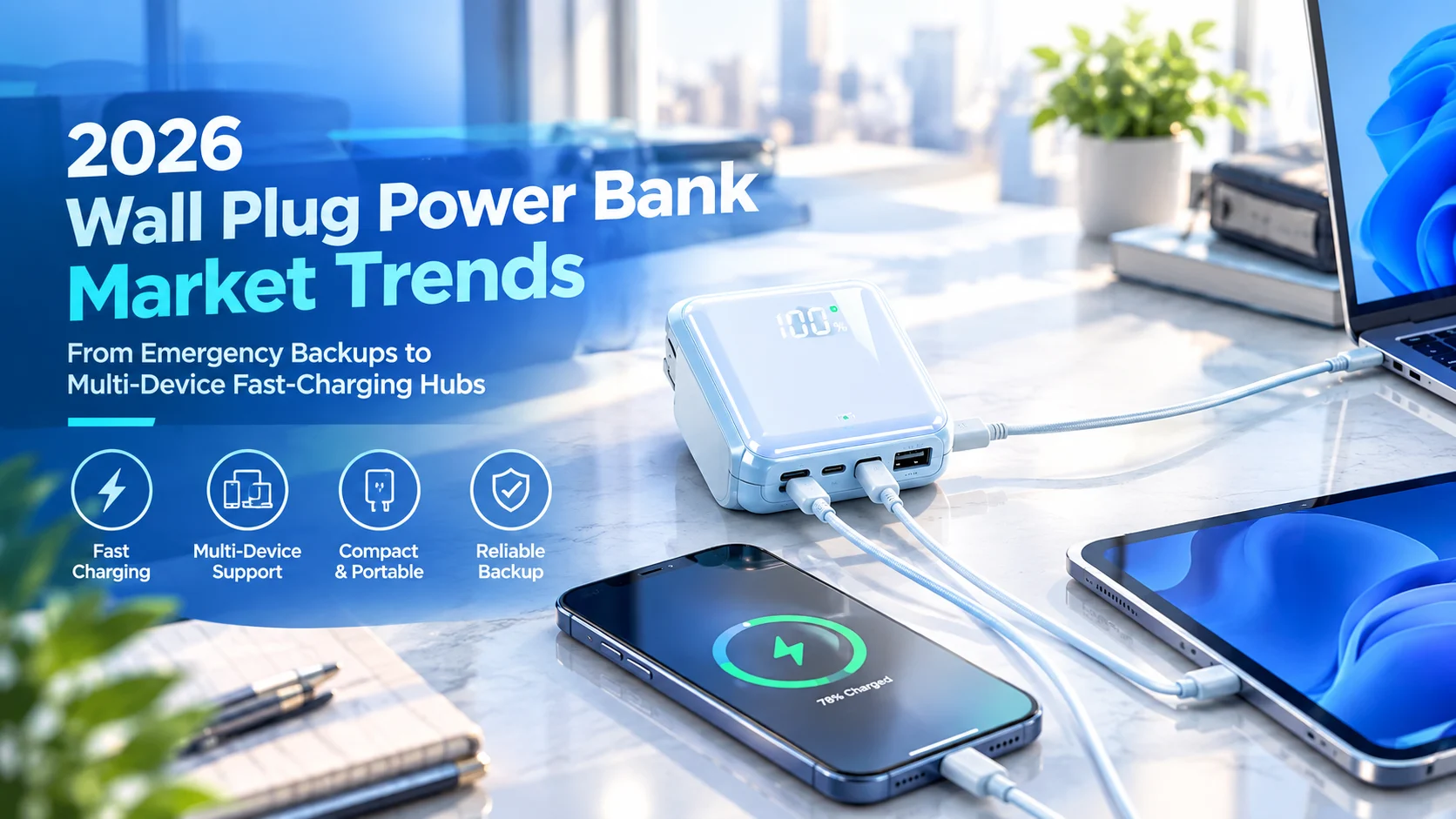
Modern products increasingly function as multi-device fast-charging power bank hubs.
For brand owners and procurement managers, this shift creates new opportunities for product differentiation.
At AiL, we help brands respond to these changing market requirements.
As a specialized portable power bank manufacturer, AiL develops market-ready portable charging solutions.
This analysis examines the key market drivers, technical evolution, and product positioning strategies for 2026.
1. Key Market Drivers: Why the Wall Plug Combo Architecture Wins
The growing adoption of the built-in AC plug power bank reflects a simple consumer demand.
Users want fewer accessories without sacrificing charging performance or flexibility.
This need has accelerated the development of all-in-one charging architectures.
Instead of carrying several separate charging accessories, users can combine essential functions into one compact device.
Eliminating Accessory Fatigue
Traditional power banks usually require several separate accessories.
Users may need a wall adapter, USB charging cable, and standalone power bank.
The all-in-one wall plug design removes much of this accessory burden.
It integrates a foldable AC plug and built-in cables directly into the battery chassis.
Therefore, users can charge smartphones while traveling with fewer accessories.
They can also connect the unit directly to a wall outlet when power becomes available.
The device can recharge itself while charging connected devices through pass-through charging.
This combination creates a more convenient grab-and-go charging experience for everyday users.
The Rise of High-Power Output
Convenience alone is no longer enough for modern mobile users.
Consumers increasingly expect portable chargers to support multiple high-power devices.
Legacy AC plug power banks were often limited to 5V/2A or 10W charging.
Modern products have expanded into 20W, 30W, 45W, 65W, and higher output levels.
This development has been supported by Gallium Nitride (GaN) semiconductor technology.
GaN enables higher power density without requiring a proportional increase in device size.
Consequently, a modern multi-device fast charging power bank can support more demanding charging scenarios.
These include smartphones, tablets, and light laptops used by mobile professionals.
Capacity Standardization
As output performance increases, battery capacity has also become more clearly segmented.
The market has consolidated around three major capacity tiers.
5,000mAh products focus on compact emergency charging and daily portability.
Their small size makes them suitable for pockets and lightweight everyday carry.
10,000mAh models provide a practical balance between portability and battery capacity.
This makes them a strong option for users who need multiple smartphone recharges.
20,000mAh models provide higher energy capacity for demanding travel scenarios.
They are particularly suitable for digital nomads and users carrying multiple devices.
This capacity segmentation gives brands a clear framework for developing differentiated product lines.
2. Market Matrix: Evolution of Built-in AC Plug Power Banks
The transition from legacy products to modern charging hubs is visible across several specifications.
| Specification Parameter | Legacy Generation (Pre-2023) | Modern Generation (2026 Trend) | B2B Market Driver & Impact |
|---|---|---|---|
| Primary Functional Role | Low-speed emergency backup | High-speed multi-device charging hub | Higher perceived value and premium retail pricing |
| Max Power Output | 5V/2A (10W Standard) | 20W / 30W / 45W / 65W+ (PD Fast Charge) | Supports fast charging for iPhones, Androids, and laptops |
| Semiconductor Tech | Standard Silicon Components | Advanced GaN (Gallium Nitride) ICs | Compact form factor with reduced thermal output |
| Integrated Cable Options | None or basic micro-USB | Built-in Type-C & Lightning cables | True grab-and-go convenience for users |
| Dominant Capacities | 3,000mAh–5,000mAh | 5,000mAh / 10,000mAh / 20,000mAh | Clear segmentation for commuter and travel lines |
| Charging Protocol | Basic USB-A output | Power Delivery (PD 3.0), QC 4.0+, PPS | Universal compatibility across smart devices |
The comparison shows that modern wall plug power banks are no longer defined by battery capacity alone.
Output power, semiconductor technology, integrated cables, and charging protocols now shape product value.
For B2B buyers, these specifications also influence target users and retail positioning.
Therefore, brands should select specifications according to the intended market scenario.
3. Product Positioning Blueprint for Consumer Brands in 2026
Once the technical direction is clear, brands need to translate specifications into user-focused product lines.
The strongest approach is to match capacity and charging power with actual usage scenarios.
This creates clearer product differentiation while helping consumers understand the value of each model.
1. Daily Commuter: 5,000mAh–10,000mAh / 20W–30W
The daily commuter segment focuses primarily on portability and convenience.
Target Audience: Urban professionals, daily commuters, and students.
For these users, a compact built-in cable power bank can provide practical everyday charging.
A foldable AC plug further reduces the number of accessories required during daily travel.
The recommended capacity ranges from 5,000mAh to 10,000mAh.
Meanwhile, 20W–30W output provides suitable fast-charging performance for common mobile devices.
The result is a compact charging solution that fits easily into jacket pockets or small bags.
2. Business Traveler and Nomad: 10,000mAh–20,000mAh / 45W–65W GaN
Business travelers and digital nomads typically have more demanding charging requirements.
They may carry smartphones, tablets, laptops, and other portable electronics simultaneously.
For this segment, 10,000mAh–20,000mAh capacity provides greater flexibility.
Meanwhile, 45W–65W GaN charging supports higher-power mobile devices.
A high-wattage configuration can power a MacBook Air or iPad alongside a smartphone.
The same product can also function as a high-speed dual-port wall charger in a hotel room.
When traveling by plane, it can operate as a high-capacity power bank.
This dual-function architecture makes the product especially attractive to frequent flyers and remote workers.
4. The AiL Manufacturing Advantage: OEM and ODM Customization
As market expectations evolve, product performance must be supported by flexible manufacturing capabilities.
Brands need more than an off-the-shelf charging product to compete in different regional markets.
At AiL, we specialize in engineering innovative and high-reliability portable charging solutions.
As an experienced portable power bank manufacturer, AiL provides end-to-end OEM and ODM support.
Flexible Plug Standards
Different international markets require different AC plug configurations.
AiL supports interchangeable or region-specific US, EU, UK, and AU plug standards.
This flexibility helps brands develop products for multiple global distribution markets.
Advanced GaN Integration
AiL supports advanced GaN charging architecture for high-wattage applications.
The circuit design focuses on high efficiency and controlled thermal performance.
This approach helps maintain lower surface temperatures during high-wattage fast charging.
Custom Built-in Cable Solutions
Integrated cables are an important part of modern wall plug power bank design.
AiL offers durable braided or TPE built-in cable solutions for customized products.
These integrated cables are tested for thousands of bend cycles.
This supports long-term usability while maintaining the convenience of an all-in-one design.
Global Safety Certifications
International distribution also requires appropriate safety and logistics documentation.
AiL supports compliance with UL, CE, FCC, RoHS, UN38.3, and MSDS standards.
These certifications and documents help brands manage international logistics and retail placement requirements.
5. How Brands Can Capitalize on the Power Bank Category Upgrade
The evolution of wall plug power banks creates opportunities across multiple consumer segments.
However, successful product development requires more than simply increasing charging wattage.
Brands should first identify their target users and primary charging scenarios.
They can then select the appropriate capacity, power output, plug configuration, and cable design.
For daily commuters, compact 5,000mAh–10,000mAh models with 20W–30W output offer a practical balance.
For business travelers, 10,000mAh–20,000mAh models with 45W–65W GaN provide stronger performance.
Integrated cables can further improve convenience across both product categories.
Meanwhile, PD 3.0, QC 4.0+, and PPS support broader device compatibility.
This scenario-based approach allows brands to build clearer product portfolios.
It also helps avoid unnecessary specifications that may increase costs without improving user value.
Conclusion: Capitalize on the Power Bank Category Upgrade
The wall plug power bank has evolved from a simple emergency accessory into a multifunctional charging hub.
This transformation reflects changing consumer lifestyles and increasing demand for portable charging performance.
Integrated cables, higher PD wattage, GaN technology, and standardized capacity tiers are reshaping the category.
For brands, these developments create opportunities to introduce more premium and differentiated charging products.
The key is to match product specifications with real user scenarios.
Daily commuters may prioritize portability, while business travelers need higher capacity and charging power.
By combining the right specifications with flexible OEM and ODM manufacturing, brands can respond more effectively to market demand.
Bring Next-Generation Portable Power Solutions to Your Market
At AiL, we develop advanced portable charging products for global consumer electronics brands.
Our OEM and ODM capabilities support customized plugs, built-in cables, GaN charging architecture, and product configurations.
From product concept and engineering to manufacturing and international compliance, AiL supports the complete development process.
Partner with AiL to develop next-generation wall plug power banks for your target market.
Contact our OEM sales team to request product catalogs, technical specifications, and custom manufacturing quotes.