
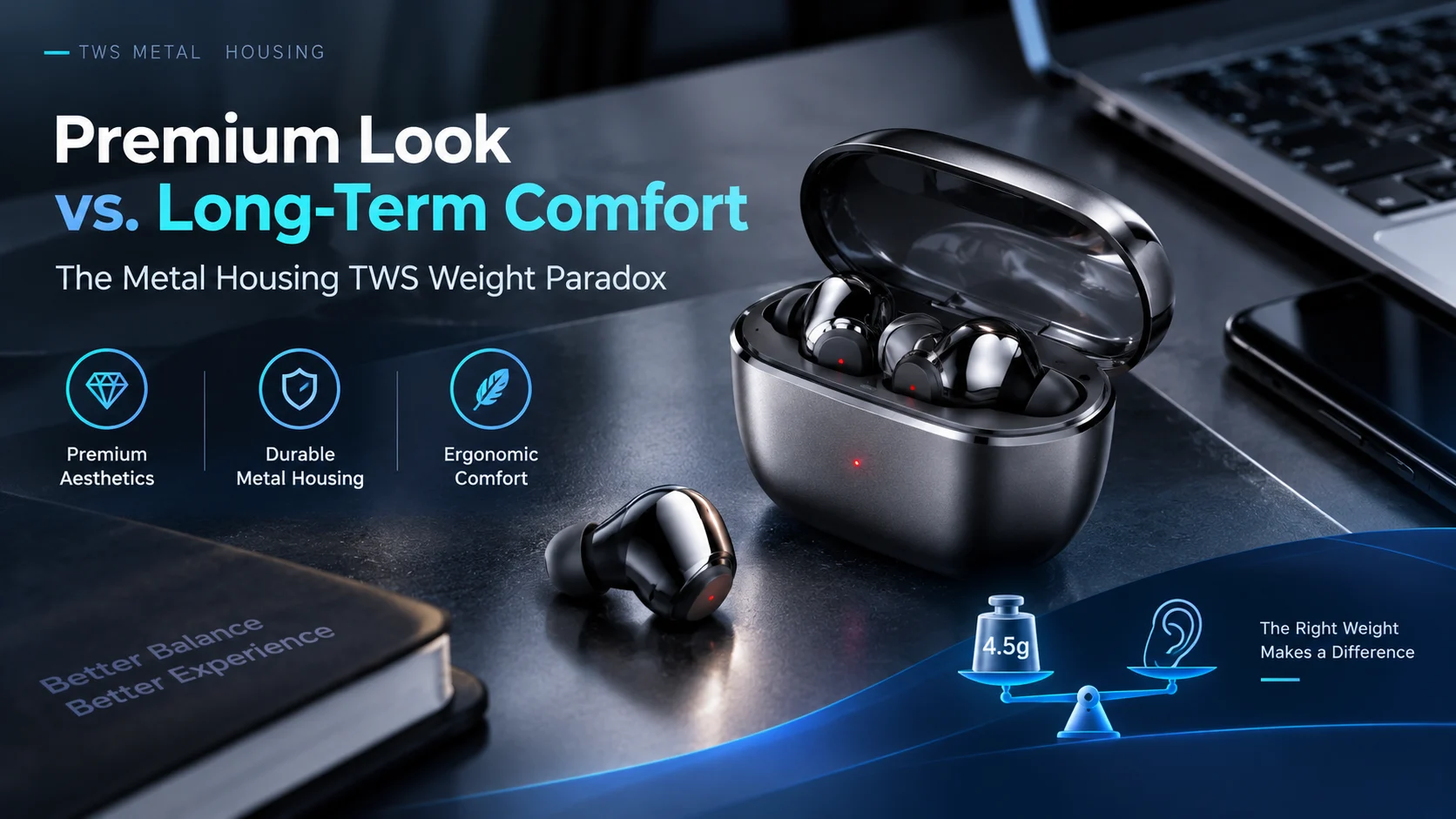
Metal Housing TWS Earbuds vs. Plastic: Weight, Comfort, and Design Considerations
For consumer electronics brands and OEM/ODM buyers, metal housing TWS earbuds offer a premium alternative to conventional plastic wireless earbuds. Aluminum alloy, stainless steel, and zinc die-cast housings can enhance perceived product value, improve structural rigidity, and create a distinctive tactile experience.
However, metal construction also introduces an important design trade-off: weight. A heavier earbud may increase pressure on the ear, affect fit stability, and reduce comfort during extended listening sessions. These effects depend on more than total mass. Center of gravity, earbud geometry, ear-tip selection, and contact with the outer ear all influence the wearing experience.
For procurement managers, understanding these factors helps determine whether metal or plastic housing better suits a product’s target market, price positioning, and intended use.
1. Metal Housing TWS Earbuds vs. Plastic: Key Differences
The choice between metal and plastic housing affects more than appearance. It also influences weight distribution, structural design, acoustic engineering, and product positioning.
The following comparison summarizes common design considerations. Actual performance depends on the specific materials, dimensions, internal components, and acoustic architecture.
| Design factor | Standard plastic housing (ABS or PC) | Metal housing (aluminum alloy, stainless steel, or zinc alloy) |
|---|---|---|
| Single-earbud weight | Approximately 4.0–5.0 g in the reference design range | Approximately 5.5–7.5 g in the reference design range |
| Wearing comfort | Lower mass can benefit extended listening and all-day wear | Requires careful weight distribution and ergonomic optimization |
| Structural rigidity | May require internal ribs and structural reinforcement | Can provide high stiffness, depending on alloy and wall thickness |
| Acoustic performance | Internal geometry and material damping help control unwanted vibration | Higher structural stiffness may help control certain housing vibrations, but acoustic performance still depends on the complete design |
| Thermal feel | Often feels less cold against the skin in cool environments | Can feel cooler in winter and warmer in hot conditions, depending on temperature and surface properties |
| Perceived product value | Suitable for mainstream and lightweight product positioning | Supports premium aesthetics and a more substantial tactile impression |
| Typical target applications | Sports, fitness, long calls, and all-day listening | Premium lifestyle audio, commuting, gaming, and design-led product lines |
These weight ranges are reference values rather than universal industry standards. Some metal designs can achieve lower weights through thin-wall construction, material selection, and hybrid structures.
Why Does Metal Housing Increase Earbud Weight?
Metal alloys generally have higher density than common housing plastics. When two housings use similar external dimensions and wall thicknesses, the metal version may weigh more.
However, material density alone does not determine final product weight. Engineers can adjust wall thickness, internal ribs, acoustic chamber geometry, and the distribution of electronic components to reduce unnecessary mass.
A hybrid construction can also combine a metal exterior with a lightweight internal plastic structure. This approach allows brands to retain a premium appearance while managing the overall weight and ergonomic performance.
For custom TWS earbud projects, procurement teams should evaluate the weight of the complete earbud rather than comparing housing materials in isolation.
2. How Does Metal Housing Affect TWS Earbud Wearing Comfort?
Wearing comfort depends on how an earbud interacts with the ear during movement and prolonged use. A heavier housing can increase gravitational force, but the location of that mass determines how much leverage it creates.
The original design reference identifies 6.0 g per earbud as a useful point for closer ergonomic evaluation. It should not be treated as a universal comfort threshold because ear shape, fit, contact area, and individual sensitivity vary considerably.
2.1 Center-of-Gravity Control
The center of gravity determines how the earbud’s mass acts relative to its contact points.
If a heavy metal shell extends outward from the ear, it can create a longer leverage arm. This may increase rotational force, place additional pressure on the ear tip, or make the earbud feel less secure.
Engineers can reduce these effects by positioning internal components closer to the ear, refining the housing contour, and keeping the mass near the ear’s supporting structures.
Key design principle: Reduce unnecessary outward mass and optimize the relationship between the center of gravity and the earbud’s contact points.
A well-balanced metal earbud may provide better stability than a poorly balanced design with a similar overall weight.
2.2 Multi-Point Support Across the Outer Ear
The ear tip is not the only component responsible for keeping an earbud in place. Contact between the earbud body and the outer ear can also help distribute loads.
The tragus, anti-tragus, and surrounding concha region may contribute to support, depending on the earbud’s shape and fit.
Ergonomic contouring can help distribute pressure across these areas instead of concentrating it around the ear canal entrance. Soft silicone ear tips or optional ear wings may further improve fit for suitable designs.
For heavier earbuds, engineers should evaluate:
- Contact pressure around the ear canal and outer ear.
- Housing contours across different ear shapes.
- Ear-tip size, material, and retention performance.
- Stability during walking, head movement, and other intended activities.
- Comfort during repeated or extended listening sessions.
The goal is not simply to make the housing smaller. It is to achieve a balanced combination of mass, fit, contact area, and retention.
2.3 Ear-Tip Selection and Seal Performance
Ear-tip geometry influences both wearing comfort and acoustic performance. An appropriate seal helps support bass response and passive noise isolation, while an unsuitable tip may cause discomfort or allow the earbud to loosen.
Memory foam and silicone tips offer different fit characteristics. Neither material guarantees a secure fit for every user.
For custom metal housing TWS earbuds, test multiple ear-tip sizes and materials with the final housing geometry. A design that works with a lightweight plastic body may need further adjustment when the mass distribution changes.
3. How to Choose Between Metal and Plastic TWS Earbuds for Different Applications
The right housing material depends on the end user’s priorities. Procurement teams should match the material choice to wearing duration, movement intensity, product positioning, and target retail price.
| Target application | Recommended design direction | Main engineering priorities |
|---|---|---|
| Premium lifestyle audio | Metal or hybrid housing | Premium finish, structural quality, weight control, and consistent assembly |
| Urban commuting | Metal, plastic, or hybrid housing | Comfortable fit, portability, noise-control features, and everyday durability |
| Mobile gaming | Metal or hybrid housing where the overall design supports it | Stable fit, low perceived pressure, microphone performance, and acoustic tuning |
| Office calls and remote work | Lightweight plastic or optimized hybrid housing | Extended-wear comfort, low mass, and reliable call quality |
| Running and fitness | Lightweight plastic or composite housing | Retention, sweat resistance, low mass, and movement stability |
| All-day listening | Lightweight plastic or carefully balanced hybrid housing | Pressure distribution, fit consistency, and long-session comfort |
Metal housing is not inherently unsuitable for sports or all-day listening. However, added mass can make retention and comfort more challenging, especially during vigorous movement.
Similarly, plastic housing does not automatically guarantee a better fit. The final geometry and mass distribution remain important regardless of material.
When Should Brands Choose Metal Housing?
Metal housing may be appropriate when premium appearance, tactile quality, and product differentiation are central to the brand’s positioning.
Potential target markets include:
- Premium consumer electronics brands.
- Lifestyle audio products designed for commuting.
- Design-focused wireless earbud collections.
- Products that emphasize a distinctive metal finish or exterior construction.
Before selecting metal, confirm that the expected retail value justifies the additional material and manufacturing considerations. The final design should also meet the brand’s requirements for comfort, durability, and production consistency.
When Is Plastic or Hybrid Housing a Better Choice?
Plastic or hybrid construction may be preferable when low weight and long-session comfort are primary selling points.
These designs can suit sports earbuds, office audio products, and models intended for extended daily use. A hybrid structure may also provide a practical compromise for brands seeking metallic aesthetics without using a fully metal housing.
The final choice should follow prototype testing rather than assumptions based on material alone.
4. Additional Engineering Considerations for Metal Housing TWS Earbuds
Weight is an important factor, but it should not be the only consideration during material selection.
Acoustic Performance and Housing Resonance
The housing affects the mechanical behavior of the earbud and its interaction with the speaker, acoustic chamber, and internal components.
Metal’s stiffness can help control certain structural vibrations. However, greater stiffness does not automatically guarantee better sound quality. Wall thickness, cavity geometry, assembly tolerances, damping materials, and driver tuning all influence the final acoustic result.
During development, engineers should evaluate frequency response, unwanted resonances, distortion, and unit-to-unit consistency using the complete earbud assembly.
Thermal Comfort
Metal surfaces can feel colder or warmer than plastic surfaces because materials transfer heat differently. The actual sensation depends on ambient temperature, surface finish, contact duration, and the product’s operating conditions.
For products intended for outdoor use across different climates, evaluate thermal comfort alongside the housing material and finish.
Water and Sweat Resistance
Metal housing does not automatically prevent water ingress. Protection depends on the complete enclosure, including joints, charging contacts, microphones, acoustic openings, seals, and interfaces between metal and plastic parts.
Hybrid structures may require particular attention to joint design and sealing consistency. For sports-oriented products, validate the complete earbud against the intended ingress-protection requirements through appropriate testing.
5. How to Evaluate Metal Housing TWS Earbuds Before Mass Production
A structured evaluation process helps procurement teams compare material options and identify ergonomic risks before committing to tooling and bulk manufacturing.
Step 1: Measure Complete Earbud Weight
Measure each finished earbud, including the driver, battery, PCB, microphone, housing, and other internal components.
Use the target product’s intended use to establish a weight goal. For designs targeting extended wear, a value below 6.0 g per earbud can serve as an initial engineering reference, but user testing should determine whether the final product is comfortable.
Step 2: Evaluate Mass Distribution
Measure or estimate the center of gravity relative to the earbud’s contact points. Review whether the outer shell creates excessive leverage or causes the earbud to rotate during movement.
Compare metal, plastic, and hybrid prototypes with similar internal electronics wherever practical.
Step 3: Conduct a Human Wear Test
A controlled wear panel can reveal comfort issues that weight measurements alone cannot identify.
A practical evaluation plan includes:
- Recruit participants with different ear shapes and sizes.
- Test the intended ear-tip sizes and materials.
- Conduct continuous listening sessions with scheduled comfort checks.
- Record pressure, pain, looseness, and perceived weight.
- Repeat testing during representative activities, such as walking or working at a desk.
A two-hour wear test with assessments every 30 minutes can serve as an initial screening protocol. It is a proposed evaluation method, not a universal certification standard. Longer tests may be appropriate for products marketed for all-day use.
Step 4: Validate Retention and Acoustic Performance
Assess whether the earbud remains stable during normal head movement and the activities specified for the product.
Also verify the acoustic seal, frequency response, microphone performance, and any active noise cancellation (ANC) requirements. Material selection should not compromise the product’s intended audio performance.
Step 5: Verify Production Consistency
Before mass production, confirm that the approved design can be manufactured consistently.
Review housing dimensions, surface finishes, assembly tolerances, sealing structures, and final product weight. Establish acceptance criteria for production samples and verify that any material or structural changes undergo appropriate review.
6. B2B Procurement FAQs
Q1: Are metal housing TWS earbuds heavier than plastic models?
They often are when the designs use similar dimensions and wall thicknesses. The actual difference depends on the alloy, housing geometry, wall thickness, and internal components.
Compare the weight of complete finished earbuds rather than relying only on material density or empty housing weight.
Q2: Do metal housing earbuds fall out more easily?
Not necessarily. Higher mass can increase gravitational pull and rotational forces, but fit geometry, center of gravity, ear-tip selection, and outer-ear support also influence retention.
For products intended for vigorous activity, evaluate stability under representative movement conditions and compare the results with lighter alternatives.
Q3: Is 6.0 g the maximum recommended weight for a TWS earbud?
No universal 6.0 g limit applies to all TWS earbuds. It is a useful design reference for identifying products that may require closer ergonomic evaluation.
The appropriate target depends on the housing design, fit, wearing duration, and intended user group. Human wear testing should validate the final decision.
Q4: Can metal housing improve TWS earbud sound quality?
Metal can provide greater structural stiffness than some plastics and may help manage certain housing vibrations. However, it does not automatically improve sound quality.
Driver characteristics, acoustic chamber design, damping, sealing, and tuning have a major influence on the final listening experience.
Q5: Are metal housing TWS earbuds suitable for sports?
They can be, provided the complete design offers suitable retention, comfort, and protection against sweat or water exposure. Nevertheless, a heavier housing may increase movement and discomfort during high-impact activities.
Lightweight plastic or hybrid designs may be easier to optimize for running and other vigorous sports.
Q6: Can OEM/ODM manufacturers customize metal housing TWS earbuds?
Customization may include housing material, external dimensions, surface finish, color, branding, internal structure, ear-tip options, and acoustic tuning, depending on the manufacturer’s capabilities.
Buyers should provide target weight, intended applications, design references, acoustic requirements, and branding specifications early in development. This allows the manufacturer to evaluate feasibility before tooling and mass production.
7. Key Takeaways for TWS Earbud Buyers
When sourcing metal housing TWS earbuds, procurement teams should balance premium appearance with wearing comfort and engineering feasibility.
- Treat weight as a design variable: Use reference weight ranges to guide development, then validate comfort through testing.
- Optimize the center of gravity: Keep unnecessary mass close to the ear and reduce outward leverage.
- Improve multi-point support: Refine housing contours and ear-tip options to distribute pressure and improve retention.
- Match materials to applications: Consider metal for premium positioning and lightweight plastic or hybrid designs for applications prioritizing extended wear.
- Validate the complete product: Check acoustic performance, retention, sealing, thermal comfort, and manufacturing consistency before mass production.
Develop Custom Metal Housing TWS Earbuds for Your Brand
Choosing the right housing material requires coordination between industrial design, mechanical engineering, acoustic tuning, and manufacturing. A well-engineered metal housing TWS earbud can deliver premium aesthetics without overlooking fit, weight distribution, and everyday usability.
If you are developing a custom TWS earbud line, share your target market, preferred housing material, weight requirements, design references, and acoustic specifications with your OEM/ODM partner.
Contact our team to discuss custom TWS earbud development, housing material options, ergonomic optimization, and wholesale manufacturing solutions tailored to your brand.