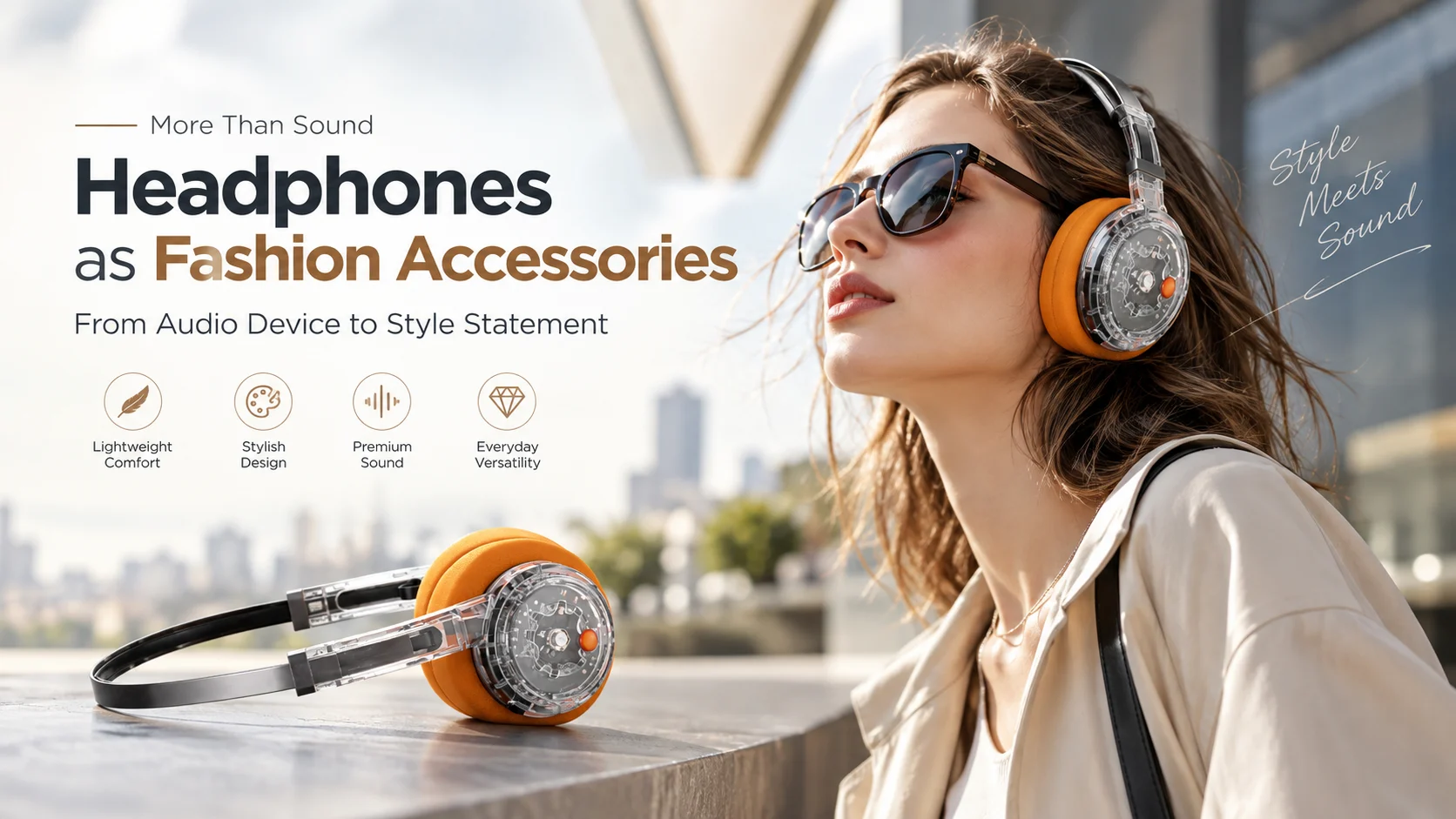
Headphones are no longer judged only by sound quality, battery life, or wireless connectivity. As wearable technology becomes increasingly integrated into everyday style, headphone fashion accessories are emerging as a new product category that combines audio performance with visual identity.
For consumers, headphones can now complement clothing, colors, hairstyles, and personal aesthetics. For brands and fashion buyers, this creates a broader product opportunity: instead of treating headphones as purely functional electronics, they can be developed as wearable audio accessories that contribute to a complete lifestyle look.
This shift is particularly relevant to over-ear and head-mounted headphones. Their larger visible surface gives designers more space to work with colors, materials, headbands, earcups, textures, and silhouettes, turning the headphone itself into part of an outfit.
Why Are Headphones Becoming Fashion Accessories?
Traditional headphones were primarily evaluated according to technical specifications.
Buyers typically asked:
- How good is the sound?
- How long does the battery last?
- Is Bluetooth stable?
- Is the microphone clear?
- Is the headset comfortable?
These factors remain important. But consumer electronics increasingly compete on another dimension: how the product looks when it is being worn.
A wearable device is different from a product that stays inside a pocket or on a desk. Its design becomes visible whenever the consumer uses it.
That makes headphones surprisingly similar to other personal accessories.
Wearable Technology Is Becoming Part of Personal Style
The broader wearable-tech market is increasingly bringing together technology, fashion, jewelry, and personal expression. Recent product collaborations have included decorative elements and fashion-brand partnerships, showing how audio and wearable products can move beyond purely technical positioning.
For consumers, this means a pair of headphones can communicate something about:
- Personal style
- Color preference
- Lifestyle
- Music culture
- Fashion taste
- Technology preferences
- Brand identity
The headphone becomes part of what other people can see.
Why Over-Ear Headphones Have Strong Accessory Potential
Different headphone formats offer different opportunities for visual design.
Earbuds are compact and discreet. Open-ear and clip-on products can introduce jewelry-like elements. Over-ear headphones, however, provide a much larger visual canvas.
This makes headphones as accessories particularly interesting from a fashion and branding perspective.
The Headband Becomes a Design Element
The headband is one of the most visible parts of an over-ear headphone.
Instead of treating it only as a structural component, designers can use:
- Metallic finishes
- Contrasting colors
- Minimalist forms
- Retro-inspired shapes
- Textured surfaces
- Soft-touch materials
- Branded details
A well-designed headband can influence the entire visual character of the product.
Earcups Create a Second Visual Canvas
The earcups are another major opportunity for customization.
A larger earcup surface can accommodate different colors, patterns, textures, logos, or material treatments.
For lifestyle brands, this opens the possibility of matching headphone colors with seasonal fashion collections.
For example:
Spring/Summer: light neutrals, transparent effects, soft colors
Autumn/Winter: darker tones, metallic finishes, warm neutrals
Streetwear: high-contrast combinations and bold graphic elements
Premium lifestyle: restrained colors and refined material finishes
The result is a product that can function as both an audio device and a visual accessory.
From “Fashion Headphones” to a Complete Styling Concept
The concept of fashion headphones becomes more powerful when the product is designed as part of an entire outfit rather than as an isolated electronic device.
A consumer may coordinate:
Clothing → Bag → Shoes → Jewelry → Headphones
In this context, headphone color and silhouette can influence the overall appearance.
Color Becomes a Commercial Product Feature
Color is especially important because it is immediately visible.
A standard black headphone may communicate practicality and universality.
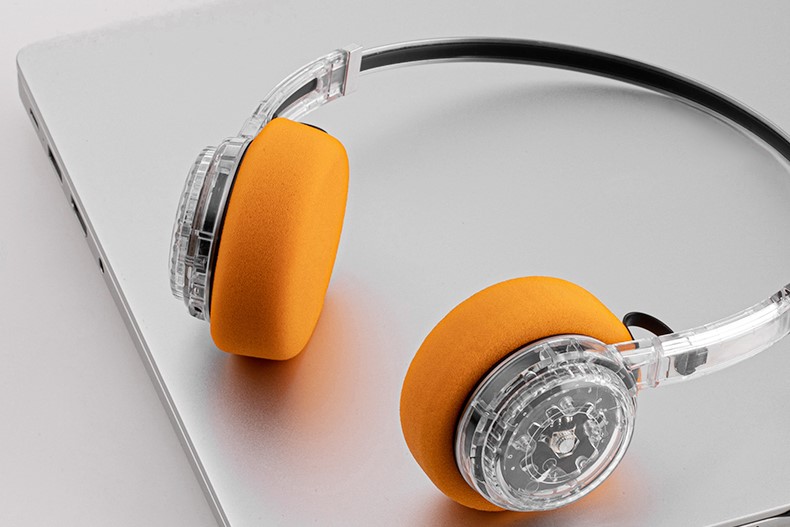
A transparent or metallic design can create a more technology-oriented aesthetic.
A warm pink, orange, or other expressive color can move the product toward youth fashion and seasonal styling.
This creates an opportunity for brands to develop multiple colorways from the same basic hardware platform.
Instead of launching one headphone model, a brand could develop a visual collection around the same technical architecture.
Why Retro Headphone Designs Are Coming Back
Fashion rarely moves in a straight line.
Products that once looked outdated can return as contemporary lifestyle objects when their visual language is reinterpreted.
Retro-inspired headphones benefit from this dynamic.
A classic head-mounted silhouette combined with modern wireless technology can create a contrast between:
Old-school appearance + modern functionality
This combination can appeal to consumers who want technology without the overly technical appearance traditionally associated with consumer electronics.
AiL’s current product range includes a retro head-mounted Bluetooth model, illustrating how a recognizable head-mounted silhouette can be combined with contemporary wireless functionality.
Why Retro Shapes Work for Lifestyle Brands
Retro design can provide a stronger visual identity than a generic minimalist electronic product.
For a fashion-oriented brand, the silhouette itself can become recognizable.
That matters because distinctive physical design can support:
- Product photography
- Social media content
- Influencer styling
- Retail displays
- Seasonal collections
- Brand collaborations
The headphone becomes easier to recognize before the consumer even sees the logo.
Materials Can Change the Perceived Positioning
Color is only one part of the accessory equation.
Material appearance also affects how consumers interpret a headphone.
A metal finish can create a more refined or industrial visual language. Wood-inspired surfaces can introduce a natural or lifestyle-oriented aesthetic. Soft-touch materials can emphasize comfort.
AiL’s current Bluetooth earphone range includes metal designs and a wood-appearance model positioned toward lifestyle and premium audio applications, demonstrating how material treatment can influence product identity.
Material Selection Should Balance Style and Function
For B2B buyers, however, aesthetics cannot be separated from engineering.
A material or surface treatment must also be evaluated for:
- Weight
- Durability
- Comfort
- Wireless performance
- Manufacturing consistency
- Surface wear
- Cost
- Production scalability
This is where product development becomes more complex than simply changing the appearance.
A successful wearable audio accessory needs the visual treatment and technical architecture to work together.
What Does This Mean for Fashion and Lifestyle Brands?
The shift toward accessory-style headphones creates a different product-development opportunity.
A traditional electronics brand may begin with a specification:
Bluetooth + battery + microphone + speaker
A lifestyle brand may begin with a different question:
What should the consumer look like while wearing this product?
Both approaches can eventually lead to the same product, but the development priorities are different.
Start With the Consumer’s Visual Context
For a fashion-oriented headphone, designers can consider:
- Who will wear it?
- What clothing styles will surround it?
- Where will it be used?
- What colors define the collection?
- Is the product seasonal or evergreen?
- Should it be subtle or highly visible?
- Does the silhouette fit the brand identity?
This makes headphone development closer to fashion-product development.
Why Headphones Have Social Visibility
One important difference between headphones and many other electronic products is that they are worn on the body.
That creates a form of social visibility.
A phone can disappear into a pocket.
A power bank can remain inside a bag.
A headphone is visible while the consumer is walking, commuting, traveling, exercising, studying, or working.
That visibility creates an additional branding opportunity.
The Product Becomes Part of the Consumer’s Image
When a product is repeatedly visible in public, design becomes part of its perceived value.
This is one reason fashion-oriented headphones can potentially support premium positioning when the visual design is distinctive and the underlying product experience is strong.
However, visual differentiation should complement—not replace—fundamental product quality.
Consumers still expect:
- Stable Bluetooth connectivity
- Good audio performance
- Comfortable wear
- Reliable battery performance
- Clear calls
- Durable construction
The opportunity lies in combining these expectations with a stronger visual identity.
How Can Brands Develop Headphones as Fashion Accessories?
For brands considering this category, product development can be divided into several layers.
Layer 1: Choose the Core Hardware
Start with the appropriate headphone architecture and technical platform.
This establishes the baseline for:
- Audio performance
- Bluetooth connectivity
- Battery capacity
- Microphone configuration
- Controls
- Charging
- Wearability
Layer 2: Define the Visual Language
Next, establish the product’s aesthetic direction.
Possible directions include:
- Retro
- Minimalist
- Streetwear
- Sporty
- Luxury-inspired
- Transparent tech
- Natural materials
- Youth lifestyle
Layer 3: Develop Color and Material Options
Colorways and surface treatments can then be developed around the brand’s visual identity.
This is particularly valuable for brands that release seasonal collections.
Layer 4: Add Brand-Specific Details
The product can incorporate:
- Custom logos
- Brand colors
- Packaging
- Button details
- Decorative elements
- Custom textures
- Collection-specific finishes
This transforms a standard electronic product into a more recognizable branded product.
Why OEM and ODM Matter in Fashion Headphone Development
For fashion and lifestyle brands, customization is important because the product needs to fit an existing brand system.
An OEM/ODM supplier can potentially support different levels of customization, from logo application and packaging to product appearance and design development.
AiL states that it provides OEM/ODM services and personalized solutions, while its product portfolio includes multiple Bluetooth earphone form factors and material-oriented designs.
For a brand buyer, this means the sourcing process does not necessarily have to begin with a completely new hardware platform.
A proven product architecture can potentially be adapted through:
Form factor + color + material + branding + packaging
This can shorten the path from concept to market while still creating a differentiated visual identity.
What Should B2B Buyers Evaluate?
Turning headphones into accessories does not mean choosing appearance over performance.
A professional buyer should evaluate both dimensions.
| Fashion & Design | Technical & Commercial |
|---|---|
| Silhouette | Bluetooth version |
| Colorways | Audio performance |
| Materials | Battery capacity |
| Headband design | Microphone quality |
| Earcup finish | Connectivity stability |
| Logo placement | Comfort |
| Packaging | Durability |
| Seasonal design | MOQ and production capacity |
The strongest products sit at the intersection of these two columns.
Aesthetic differentiation attracts attention; product performance supports repeat demand.
The Future of Headphones as Wearable Audio Accessories
The evolution of headphones reflects a broader change in consumer electronics.
Technology is becoming increasingly personal, visible, and style-driven.
For headphones, this creates an opportunity to move from:
Listening device → Personal technology → Wearable accessory
The larger visual footprint of over-ear headphones makes them particularly suitable for this transition. Headbands, earcups, colors, materials, and silhouettes all provide opportunities for differentiation.
At the same time, emerging collaborations between technology and fashion demonstrate that wearable products can increasingly occupy both categories simultaneously.
For lifestyle brands and fashion buyers, the opportunity is therefore not simply to source another pair of Bluetooth headphones.
It is to develop an audio product that looks like it belongs to the brand’s world.
Key Takeaways
The rise of headphone fashion accessories does not mean that sound quality and technology have become less important. Instead, the category is expanding.
Modern consumers can evaluate a headphone through two connected questions:
How does it sound?
and
How does it look when I wear it?
That second question creates new opportunities for fashion brands, lifestyle companies, retailers, and buyers.
Over-ear headphones are particularly well positioned because their visible headband and earcup structure provide substantial space for colors, materials, retro styling, branding, and seasonal design.
For B2B buyers, the key is to combine audio performance, comfort, manufacturing feasibility, and visual identity from the beginning of product development.
The most effective fashion-oriented headphone is therefore not simply a decorative electronic device. It is a wearable audio accessory designed to perform as well as it looks.
For brands exploring this category, an experienced OEM/ODM supplier can help translate a visual concept into a manufacturable product while balancing customization, performance, packaging, and production requirements.