
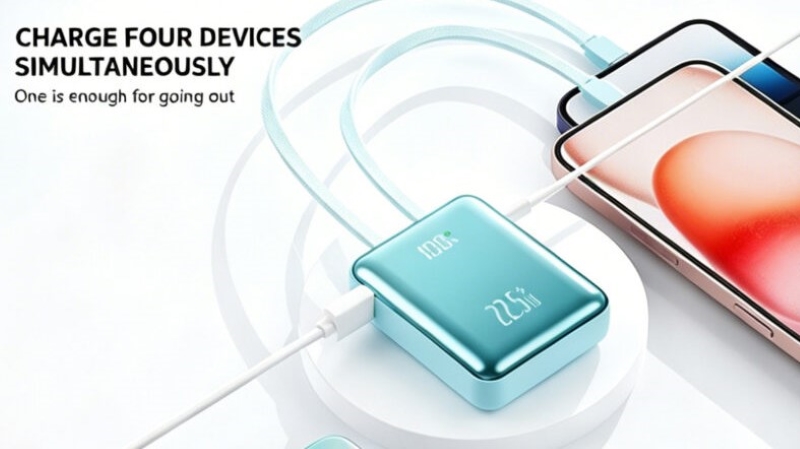
Modern consumers carry multiple electronic devices like smartphones, tablets, and wireless earbuds every day. Consequently, high-capacity portable chargers have become an essential accessory for managing daily power needs. Many premium battery packs proudly advertise support for simultaneous charging of 4 devices in power bank architectures.
However, users frequently complain that charging speeds drop significantly when plugging in multiple devices at once. This slowdown happens due to physical battery safety limits and smart energy management choices. This technical guide explains the engineering limits of portable batteries and reviews how smart power distribution keeps your hardware safe.
1. The Physics Behind the 22.5W Single-Cell Output Limit
To understand multi-port slowdowns, you must examine the physical boundaries of internal lithium battery design.
 Single 3.7V Battery Cell ──> Boost Circuit Max Threshold ──> ❌ Hard 22.5W Power Ceiling
 Multiple Series Cells    ──> High-Voltage Step-Down     ──> ♻️ Supports 65W-100W Laptop Loads
A standard compact power bank utilizes a single high-capacity 3.7V lithium polymer cell inside its chassis. To deliver fast charging, the internal boost circuit must step up this native voltage to 5V, 9V, or 12V.
Engineering teams cap this single-cell architecture at a maximum output threshold of 22.5W. Pushing a single cell past this limit generates extreme heat, which shortens battery lifecycles and creates safety hazards. Therefore, supporting higher wattages like 65W or 100W requires wiring multiple battery cells together in a series circuit.
2. The Multi-Port Power Sharing Logic Matrix
When you connect multiple devices, the internal controller switches from fast-charging mode to a safe multi-port power-sharing routine. Review this operational breakdown to see how power shifts based on load:
| Connected Device Count | Total Available System Output | Internal Power Distribution Logic | Primary Recommended Use Case |
| 1 Device (Single Port) | Peak 22.5W Output | Allocates 100% of available power to the active port. | Rapidly top off your primary smartphone. |
| 2 Devices Connected | Shared 15W Max Limit | Grants Type-C power priority over auxiliary lines. | Charge a phone and a wireless earbud case. |
| 3 Devices Connected | Shared 15W Max Limit | Monitors active loads to balance current dynamically. | Share backup power across group road trips. |
| 4 Devices Connected | Shared 15W Max Limit | Splits power evenly into a stable 5V/3A energy pool. | Safe overnight charging inside a hotel room. |
3. The Smart Value of Intelligent Power Distribution
To manage multiple devices safely, modern battery packs utilize a specialized power management integrated circuit (PMIC).
                  Unoptimized Multi-Port vs. Intelligent Control:
   ┌──────────────────────────────────────────────────────────────────┐
   │ Legacy Charger: Forces a rigid power drop, causing disconnects.  │
   ├──────────────────────────────────────────────────────────────────┤
   │ AiL Smart PMIC: Dynamically balances current to keep lines live. │
   └──────────────────────────────────────────────────────────────────┘
This advanced controller handles intelligent power distribution by constantly scanning each charging port. When you plug in a second or third device, the chip recalculates the power requirements instantly.
Instead of shutting down the power block entirely, it smoothly steps down the voltage to a uniform $5\text{V}$ pool. This smart regulation prevents overcurrent damage, reduces internal heat buildup, and keeps all connected devices charging safely.
4. Protecting Low-Current Accessories via Safe Charging Modes
Standard high-output power banks often struggle to detect miniature smart accessories like smartwatches and wireless earbuds.
 Low Current Accessory ──> Below Detection Threshold ──> ❌ Power Bank Automatically Shuts Off
 Low Current Accessory ──> Activated Trickle Mode    ──> ♻️ Safe, Uninterrupted Micro-Charging
Because these small devices draw very little electrical current, standard chargers assume the line is empty. Consequently, the battery pack turns off automatically, leaving your accessories dead.
Our advanced power packs solve this issue by integrating a dedicated low-current trickle charging mode. This specialized mode maintains a continuous, low-wattage energy stream without triggering auto-shutdown safety routines. It keeps your low-power gear charging steadily without damaging its delicate internal micro-batteries.
Multi-Port Charging Performance Comparison
| Hardware Engineering Profile | Cheap Economy Multi-Port Power Banks | AiL Intelligent Power Banks |
| Simultaneous Load Capacity | Drops power randomly or shuts down completely | Balances power smoothly across 4 devices |
| Type-C Port Performance | Shares identical priority with USB-A lines | Features advanced Type-C power priority |
| Small Accessory Safety | Repeatedly stops charging low-power devices | Dedicated trickle mode protects small gear |
| Internal Heat Management | Runs hot when handling multiple connections | Smart PMIC monitors and limits thermal spikes |
| Ideal Travel Utility | Requires carrying multiple charging bricks | Functions as a clean, unified travel hub |
Conclusion: Future-Proof Your Mobile Power Management
Smart devices require smarter and more versatile charging solutions. Avoid carrying multiple adapters or using inefficient portable chargers. Instead, upgrade to a power bank that charges four devices simultaneously.
This solution creates a convenient and organized mobile power station. Moreover, it delivers stable charging speeds across multiple ports. Advanced protection systems help prevent battery damage and overheating. As a result, your devices stay safe throughout every journey.
We engineer each component for maximum efficiency and reliability. Therefore, users enjoy dependable power whenever and wherever needed.
Contact the AiL technical sales team for product samples. Request wholesale pricing and explore your next bulk order today.