Navigating the Evolution of Magnetic Wireless Standards
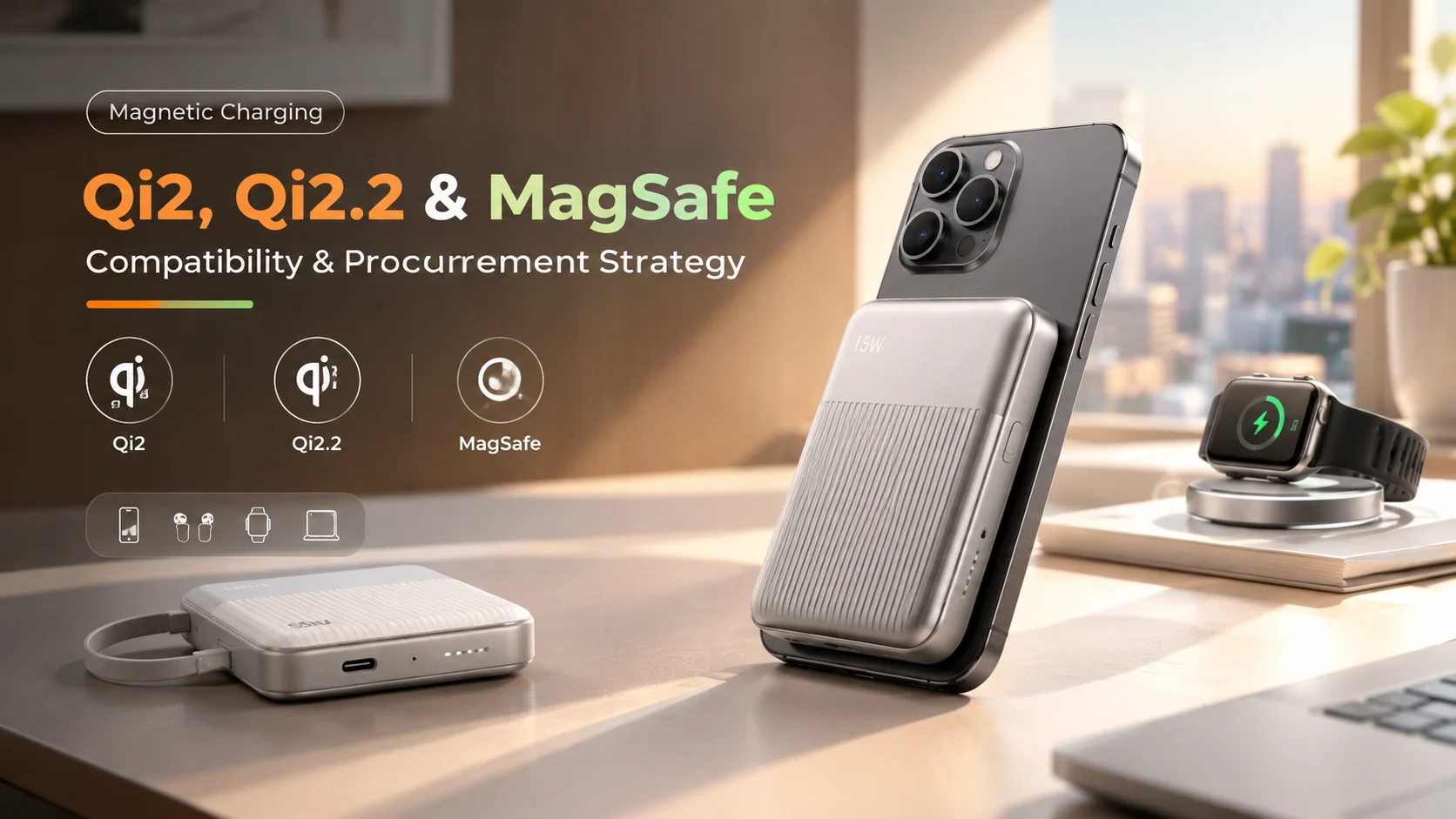
For consumer electronics brands, retail buyers, and distribution managers, selecting the right magnetic power bank inventory requires balancing fast-evolving tech specs with broad market adoption. The transition from Apple’s proprietary MagSafe to the Wireless Power Consortium’s (WPC) open Qi2 standard—and now the latest Qi2.2 (25W) protocol—has created confusion regarding device support, charging speeds, and inventory longevity.
Procurement managers often ask whether investing in higher-spec Qi2.2 magnetic power banks will exclude owners of older smartphones.
In reality, specifying Qi2.2 represents a “future-proof plus backward-compatible” sourcing strategy. Qi2.2 power banks deliver peak 25W wireless fast charging to the latest flagship devices while remaining fully functional at 15W, 7.5W, or 5W for legacy phones.
Understanding these technical nuances ensures your product lineup serves both early adopters and the mass market effectively.
1. Technical Breakdown: Qi2 vs. Qi2.2 vs. MagSafe
Understanding standard differences is essential when evaluating manufacturer spec sheets and component bills of materials (BOM):
- Apple MagSafe (Proprietary Standard): Apple’s original magnetic alignment system, delivering up to 15W to compatible iPhone models (iPhone 12 through iPhone 15 series).
- WPC Qi2 (15W Open Standard): Introduced magnetic power profile (MPP) architecture to the broader market, standardizing 15W magnetic wireless charging across both iOS and supported Android ecosystems.
- WPC Qi2.2 (25W Next-Gen Standard): The latest WPC standard boosting peak wireless power output up to 25W. Featuring advanced thermal monitoring and enhanced energy conversion efficiency, it provides maximum wireless charging speeds for current flagship devices while maintaining full backward compatibility with all previous Qi and Qi2 profiles.
2. Technical Comparison Matrix: Magnetic Power Bank Standards
The table below compares key engineering parameters across all three magnetic charging profiles to help inform product development decisions.
| Specification / Attribute | Apple MagSafe (Legacy) | WPC Qi2 (Standard MPP) | WPC Qi2.2 (Next-Gen MPP) |
| Maximum Wireless Power Output | Up to 15W | Up to 15W | Up to 25W |
| Core Ecosystem Support | Apple iPhone 12–15 Series | iOS & Select Android (15W) | Latest Flagships (e.g., iPhone 17 series, S26 Ultra) & Legacy Devices |
| Backward Compatibility | Qi1.0 (5W–7.5W fallback) | Qi1.0 / Legacy MagSafe | 100% Backward Compatible (15W / 7.5W / 5W) |
| Magnetic Alignment Mechanism | Apple Proprietary Ring | WPC Standardized MPP Ring | WPC Standardized MPP Ring (Enhanced Retention Force) |
| Thermal & Efficiency Profile | Standard Passive Cooling | Standard Thermal Throttling | Advanced Active/Passive Thermal Control (Low Heat) |
3. Procurement Q&A: Key Technical & Commercial Queries
Q: Can a 25W Qi2.2 Power Bank Charge an Older Device Like the iPhone 12?
Yes, completely. The Qi2.2 protocol is fully backward-compatible. When a user attaches an older device (such as an iPhone 12, 13, or early Qi2-compatible phone) to a Qi2.2 power bank, the two devices execute a hardware handshake.
The power bank identifies the receiver’s maximum power limit and adjusts its transmission down to 15W or 7.5W. The phone charges safely at its maximum supported rate without risk of overvoltage, excessive heat, or battery strain.
Q: What Is the Real-World Charging Speed Gap Between 15W and 25W Wireless Output?
While a jump from 15W to 25W represents a ~66% increase in theoretical power delivery, real-world battery replenishment times depend heavily on thermal dissipation:
[0% to 50% Battery Top-Up Comparison]

15W Standard Qi2 / MagSafe : █ █ █ █ █ █ █ █ █ █ █ █  (~45 to 55 Minutes)
25W Qi2.2 Fast Charge     : █ █ █ █ █ █ █              (~30 to 35 Minutes)
- 25W Qi2.2 Profile: Capable of pushing a compatible flagship battery from 0% to 50% in approximately 30 to 35 minutes.
- 15W Qi2 / MagSafe Profile: Typically takes 45 to 55 minutes to reach the same 50% mark under similar ambient temperatures.
For end-users, 25W wireless charging provides a quick-charging experience that approaches traditional wired speeds during short top-up sessions.
Q: Built-In Integrated Cable vs. Pure Magnetic Wireless: Which Form Factor Delivers Better Market Utility?
When customizing power bank hardware for retail distribution, choosing the right form factor depends on target buyer use cases:
- Pure Magnetic Wireless Design:
- Pros: Sleek, pocketable footprint; zero cable clutter; highly appealing for urban commuters and minimalists.
- Cons: Wireless charging inherently suffers higher thermal power loss than wired connections.
- Integrated Cable + Magnetic Wireless Hybrid Design:
- Pros: Maximum versatility. Users can magnetically attach the power bank for wireless convenience or pull out the integrated USB-C cable to unlock maximum wired PD fast charging (e.g., 30W–45W output) or power non-wireless accessories simultaneously.
- Cons: Slightly larger housing footprint and slightly higher assembly BOM cost.
Technical Knowledge Summary
Navigating the magnetic power bank market requires matching product specifications to consumer device trends. While legacy MagSafe and standard Qi2 (15W) solutions cover older smartphones, Qi2.2 (25W) delivers higher power, improved thermal efficiency, and universal backward compatibility. Choosing Qi2.2 hardware ensures your inventory supports next-gen 25W wireless flagships while serving older 15W and 7.5W devices seamlessly.
Partner with Custom Power Bank Specialists
Looking to expand your brand’s magnetic power bank lineup? Contact our product engineering team to discuss custom OEM/ODM solutions, request Qi2.2 sample evaluations, or receive personalized BOM and pricing structures for your upcoming production run.