
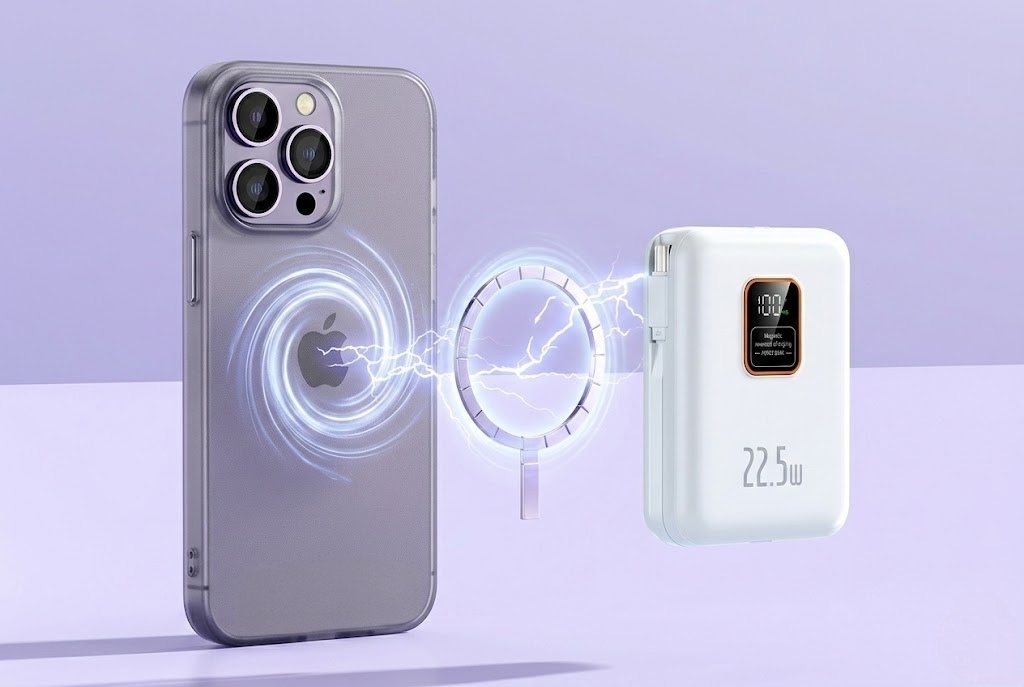
For users of modern magnetic wireless charging, convenience is defined by a seamless “snap-and-charge” experience. However, the most frequent hesitation buyers express before purchasing a magnetic wireless accessory is a logistical one: “Will this actually work through my protective phone case, or will I have to peel the case off every single time I need a charge?”
This concern is entirely valid. Traditional low-grade wireless chargers frequently suffer from severe alignment issues or complete power drops the moment a layer of plastic or leather is introduced between the coils. To solve this, advanced hardware manufacturing has shifted toward high-coercivity magnetic arrays. By engineering a magnetic power bank with case optimization in mind, modern portable chargers use industrial-grade magnetic fields to completely bypass the physical casing barrier.
This technical guide explores the physics of magnetic attenuation through different case materials and outlines how premium magnetic arrays maintain absolute charging stability.
1. The Physics of Attenuation: Magnetic Strength vs. Case Thickness
To understand how a portable charger preserves its grip through a protective barrier, we must look at the behavior of magnetic flux density. Magnetic force does not degrade linearly; instead, it is governed by the Inverse-Square Law.
  Direct Contact (0mm Gap):       [Power Bank Magnet] ──> [Phone Magnet] = 100% Grip Force
  Standard Case (2mm Gap):        [Power Bank Magnet] ── [Case] ── [Phone] = 40% Grip Force Loss
  Industrial N52 Compensation:   [Heavy N52 Core] ─── (37% Boost) ───> Overcomes 2mm Drop
- The Thickness Penalty: A standard protective phone case introduces a physical gap of 1.5mm to 3.0mm. According to the inverse-square law, a minor 2mm separation can cause a standard magnet’s retention grip to drop by over 40%, leading to a weak connection where the power bank easily slides off.
- The N52 Neodymium Solution: To compensate for this structural drop-off, premium magnetic power banks bypass standard commercial magnets. Instead, they integrate custom-engineered N52 Neodymium (NdFeB) magnetic arrays. N52 represents the highest industrial grade of magnetic energy product commercially available. By packing these hyper-dense magnets into a precise, multi-pole circular orientation, the hardware generates a concentrated flux field. This architecture delivers a verified retention force that can easily withstand aggressive movement even through a 2.5mm material barrier.
2. Compatibility Matrix: How Different Case Materials Affect Magnetic Trajectory
Not all phone cases interact with magnetic fields in the same way. The raw atomic structure of the case material determines the level of magnetic transmission:
Polycarbonate (PC) & Acrylic Cases (Excellent Transmission)
Hard, clear plastic cases feature low magnetic permeability, meaning they do not redirect or shield the magnetic flux lines. An N52-fortified power bank easily penetrates these materials with minimal grip degradation.
Liquid Silicone & TPU Cases (High Friction Countermeasures)
Silicone and Thermoplastic Polyurethane (TPU) add a slight dampening effect to the magnetic pull due to their elastic thickness. However, high-quality silicone cases compensate for this via surface friction. The rubberized texture acts as a non-slip mechanical brake, preventing the power bank from rotating or sliding out of alignment.
Genuine Leather Cases (Variable Attenuation)
Leather is a dense, fibrous organic material that often runs thicker ($>2.5\text{mm}$) than synthetic shells. For stable connection consistency, leather cases require an integrated internal magnetic ring adapter to catch the power bank’s field line.
Aramid Fiber / Kevlar Cases (The Premium Standard)
Aramid fiber patterns are exceptionally thin (often under 0.6mm) while providing military-grade drop security. Because the material profile is so thin, it allows the power bank’s magnetic array to achieve near-direct contact with the phone’s internal core, ensuring peak holding power.
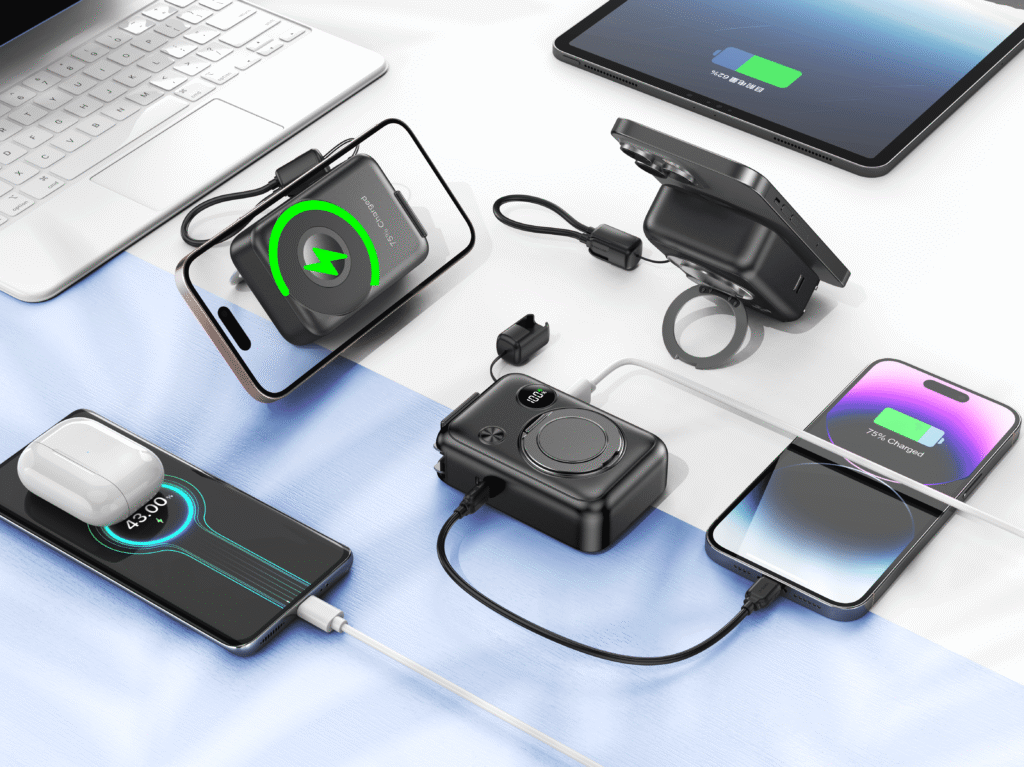
3. The “Too Thick” Warning: When Does Case Geometry Interfere?
While an industrial-grade magnet-strength phone case array handles standard daily enclosures with ease, there are specific physical boundaries where structural interference can compromise charging efficiency:
- The 4mm Structural Threshold: If a heavy-duty tactical armor case or a multi-layer wallet case exceeds a thickness of 4.0mm, the physical separation moves past the effective range of the magnetic flux field. At this distance, the retention force drops below safe handling thresholds, and the inductive charging efficiency decays, transforming lost energy into excess heat.
- Metals and Carbon Blockers: Cases that incorporate real aluminum accents, integrated kickstands made of zinc alloys, or metal plate inserts designed for magnetic car mounts will block the wireless charging signal completely. These metals create a barrier that triggers the power bank’s Foreign Object Detection (FOD) safety protocol, instantly shutting down power transmission to prevent dangerous thermal buildup.
 [Heavy 5mm Armor Case] ───> [Excessive Distance] ───> Flux Field Fails / Induced Thermal Heat
 [Metal Kickstand Layer] ───> [FOD Sensor Trigger] ───> Automatic Safe Power Shutdown
4. Adaptation Solutions for Legacy and Non-Magnetic Devices
To ensure that users with older smartphone variants or non-magnetic cases can still utilize a high-performance MagSafe-compatible case setup, modern portable ecosystems offer hardware optimization kits:
- Universal Adhesive Magnetic Ring Adapters: For standard cases lacking an internal array, manufacturers supply an ultra-thin, adhesive ferromagnetic alignment ring. This ring is applied directly to the exterior back center of the phone case using high-strength adhesive. This relocates the magnetic contact point to the outside of the case barrier, eliminating thickness attenuation and providing a rock-solid docking connection for any magnetic power pack.
Phone Case Compatibility Sourcing Matrix
| Case Material Classification | Material Thickness Window | Magnetic Retention Stability | Wireless Charging Efficiency |
| Aramid Fiber (Kevlar) | 0.4mm – 0.8mm | Ultra-Strong (Near Native) | Maximum (98% Efficiency) |
| Hard Polycarbonate (PC) | 1.0mm – 2.0mm | Strong & Secure | High (92% – 95% Efficiency) |
| Liquid Silicone / TPU | 1.5mm – 2.5mm | Stable (Enhanced by surface grip) | Moderate to High (88% – 92%) |
| Thick Leather / Wallet | 2.5mm – 3.5mm | Moderate (Requires internal ring) | Moderate (80% – 85% Efficiency) |
| Heavy Tactical Armor | > 4.0mm / Metal Trims | Unsafe (High drop risk) | Prohibited (Triggers FOD safety shutoff) |
Conclusion: Formulating Zero-Friction Portability
In the fast-paced mobile accessory industry, convenience should never require structural compromises.
Stop forcing your customers to choose between rugged drop protection and effortless wireless charging. By standardizing your inventory on a premium magnetic power bank with case architectural optimization—powered by high-density N52 Neodymium arrays—you deliver a reliable, high-efficiency charging workflow that cuts through case barriers with ease.
Explore AiL’s latest catalog of custom-engineered magnetic power banks today to find hardware built for seamless, zero-compromise daily power.